The quote is sitting on the desk. One line for the plain white rolls you have always bought at about $1.30 each, one line for sticky receipt paper at nearly $9 a roll, and a rep on the phone explaining how much labour it saves. Eight times the price. For paper.
He is not lying, exactly. There is a version of your operation where that roll pays for itself twice over, and a version where it becomes the most expensive line in your consumables budget. The difference has almost nothing to do with the paper. It comes down to one question: does your ticket get stuck to anything?
The Actual Price Gap Between Sticky, Colored And Plain Receipt Rolls
A case of fifty plain white 3 1/8" x 230' rolls from a bulk thermal receipt roll supplier costs $55–$97, so $1.10–$1.95 a roll, or $1.18–$1.48 on contract volume, in 48 GSM or 55 GSM. Narrow 2 1/4" x 85' runs $27–$35 a case, $0.55–$0.70 a roll.
Colour moves that number, but not far. Yellow 3 1/8" x 230' costs $89.65–$132.25 a case, blue starts at $88.79 and reaches about $155.25 at single-case volume, green 3 1/8" x 220' is $119.95 falling to $107.95 at 25–49 cases, and edge-stripe white is $116.50, or $2.33 a roll. Colour costs 1.5x–2.5x plain white at identical 230-foot length, so the per-foot premium is the same multiple. Same class of purchase.
Sticky is where the floor drops out. Iconex MAXStick PlusD, 3 1/8" x 170' diamond adhesive, 32 per case: $274.97–$302.49, so $8.59–$9.45 a roll. Another listing for the same spec asks $349.95 for a single case and $299.95 at 2–24, landing at $9.18–$10.94. MAXStick X2, 2 1/8" x 170' full adhesive, is gentler at $239–$256 a case, $7.47–$8.00. Six to ten times plain white.
Per roll is the wrong unit anyway, and it flatters the sticky stock, since sticky rolls carry 160–170 feet against 150–230 for plain. Per foot: plain $0.0048–$0.0065, coloured $0.0078–$0.0115, PlusD $0.0505–$0.0644. The honest gap is 8x–12x, plus the extra roll changes a short roll forces on every shift.
Against paper, linerless loses every time, so change the comparison. Put one sticky roll against the bundle it replaces: receipt roll, die-cut order labels at $0.03–$0.06 each, liner haul-away, and two SKUs to buy, store and reorder. Liner is roughly half the material weight of a conventional label and most municipal streams will not recycle it. At matched diameter, linerless carries 40%–60% more labels — Zebra and Avery Dennison cite about 50%, Iconex about 40% — which halves inbound freight and warehouse footprint. MAXStick also has no black sensing mark and cuts at any position, giving about 17% more receipts per roll than mark-sensing stock.
Two Scenarios Where Sticky Receipt Paper Genuinely Pays Back
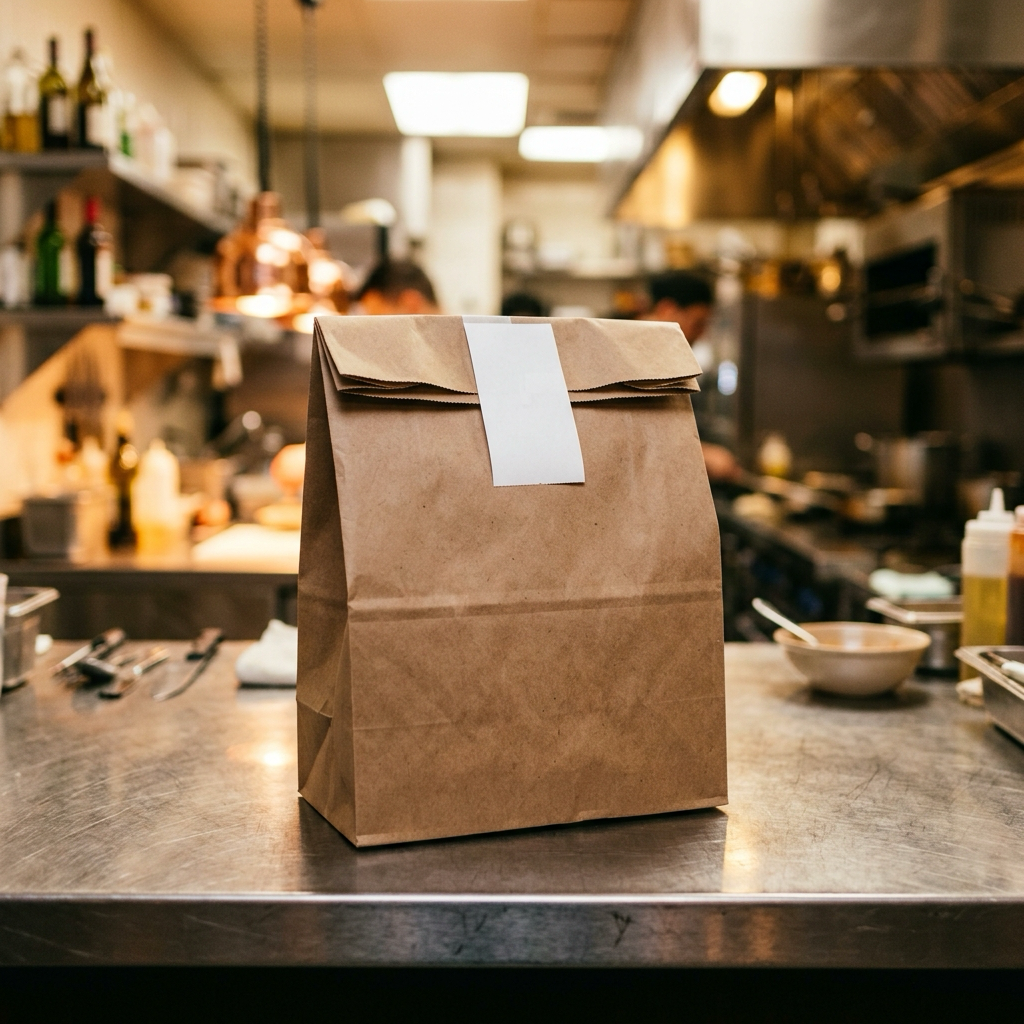
A folded kraft bag with the receipt laid across the fold is the strongest case anyone has made for linerless. The receipt is the seal: tear it to open the bag and the evidence shows, which removes a separate tamper-evident security label SKU and the peel-and-apply motion with it. One print plus one press replaces print, peel off the liner, align, apply. At 200–400 delivery orders a day, that saved motion is the payback. The paper price never was.
Adhesive grade decides whether the seal is real. Removable low-tack suits everyday QSR takeout where the customer lifts the receipt off cleanly, and gives no tamper evidence. Semi-removable holds on rough kraft without tearing fibre on removal. Permanent is the only grade with genuine tamper evidence, since removal destroys the label or tears bag fibre, and third-party delivery platforms insist on it. Then one detail decides the rest: fold the bag top, lay the receipt across the fold so it bridges both faces, press the full seam. A receipt stuck to one face is decoration.
The second scenario adds up faster. Linerless cuts to content length, so a single-drink ticket prints short and an eight-item customised order prints long off one roll. Die-cut labels from a custom die-cut roll label printing service must be sized for the longest order, so every short ticket wastes 2–3 inches of blank tail — on a 10,000-ticket month at 60% short tickets, roughly 1,200–1,800 feet of paid stock binned. One 3 1/8" roll also collapses small cup, large cup, bag, box and clamshell SKUs into a single reorder point. Common food-service formats: 3 1/8" x 263' peel-removable and 3 1/8" x 270' full-coverage.
Then the line nobody puts in the business case. At 4x6 equivalent, a die-cut roll of wholesale 4x6 direct thermal labels holds about 250 labels against 350–400 for linerless at the same diameter, cutting roll changes 40%–65% per shift. Each change costs 45–90 seconds with the station down, so killing 3–5 changes during a lunch rush beats the few cents plain stock saves.
The counter-example covers more stations than buyers admit. Checkout printing, where the receipt goes into a hand or a pocket, never uses the adhesive, so the 6x–10x premium buys nothing. Same verdict for card-slip printers and self-checkout validation slips. The test is one sentence: does the ticket get stuck to a physical object as part of the workflow?
Choosing The Adhesive Pattern: Full, Center, Diamond Or Edge Coverage
Ask a POS receipt roll manufacturer for "half sticky, half plain" and you will get quoted full coverage, because full coverage is the default stock item. The complaint that follows is always identical: the receipt cannot be torn off for the customer. That is not a defect. You bought the wrong pattern.
Full coverage means stick it and never take it off — chilled and frozen bag closures, catering trays, shrink-wrapped trays. There is no customer copy, so it has no business on a printer that also prints receipts. Centre adhesive is what most buyers actually want: a band down the middle grips the container while blank side edges stay free to grip and tear. One ticket, two jobs, one printer. Full coverage forces a second printer for the customer copy, and that swing costs more than the paper spec ever will. Diamond dot, which MAXStick PlusD provides, exists for curved cup walls, wrinkled kraft and ribbed clamshells, where discrete dots point-load instead of sheet-load so the label conforms rather than bubbling. Side-edge is narrower: sealing one edge of a bag flap, or tacking a ticket to a shelf edge.
Residue belongs in the spec, not in your hopes. MAXStick's formulation is specified to leave no residue on cutter blades or tear bars, and that single property drives cleaning frequency and unplanned downtime more than any other adhesive attribute. Write it into the PO as an acceptance condition instead of discovering it after a pallet lands. Diamond dot transfers least to the blade path; full coverage transfers most.
Basis weight is two grades and one trade-off. 15# (about 55 gsm) is thinner, gives more feet per roll and fewer roll changes, but conforms poorly to strong curves. 21# (74–80 gsm) is stiffer, conforms better on curved cups and pleated bags, prints with better contrast on textured surfaces, and gives fewer feet. Curved packaging points to 21#, flat bags and boxes at high volume to 15#. Iconex MAXStick covers most pattern and weight options, with Nashua and TE Connectivity constructions worth quoting alongside. Widths and core sizes outside those catalogues come down to in-house slitting and die-cutting capacity.
The Printer Bill Nobody Includes In The Sticky Roll Quote
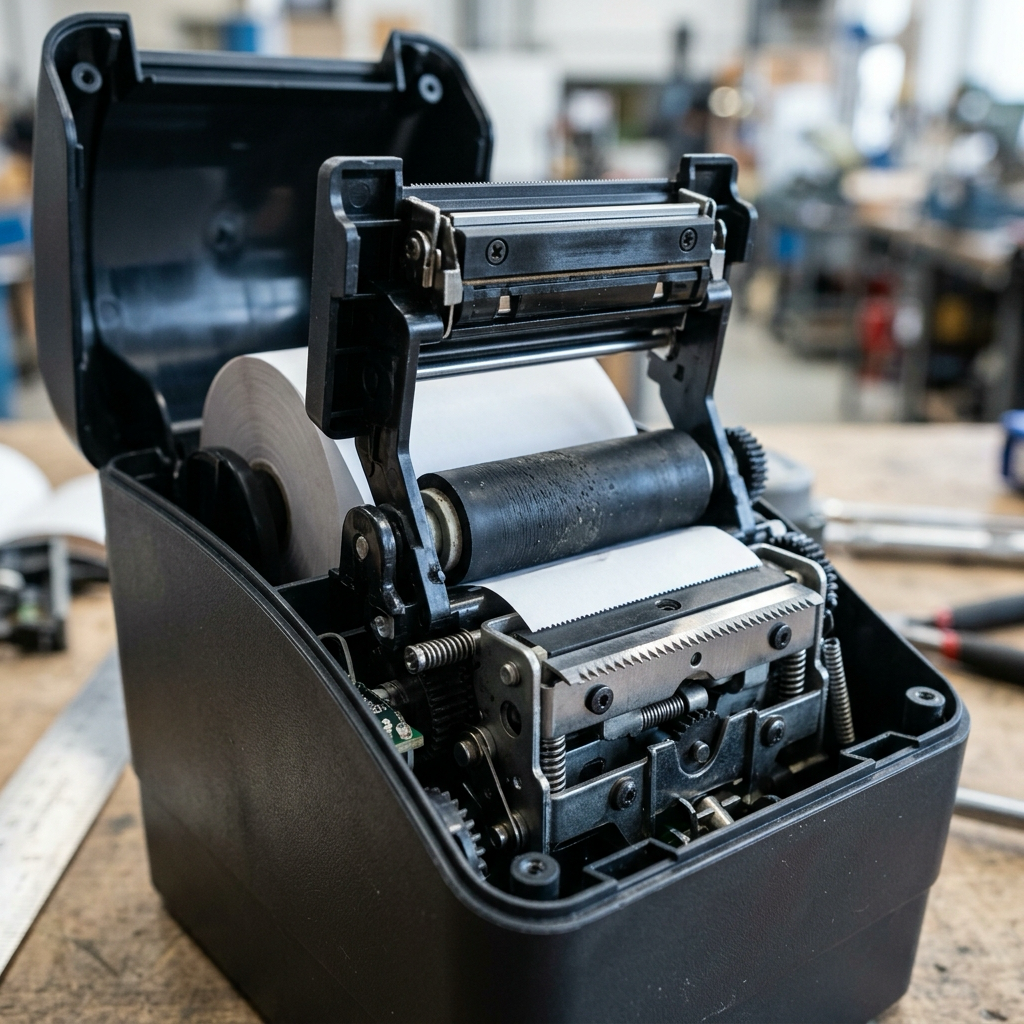
The roll quote is not the whole quote, and this is where most linerless ROI models quietly fall apart. With no liner to buffer it, adhesive touches the platen roller on every pass. A rubber platen picks up adhesive within a low print volume, glazes, then slips or skews the media, and cleaning does not bring it back. A silicone-coated platen is mandatory. On Zebra hardware you can spot it by colour, since the linerless roller is dark brown rather than the usual black rubber.
The cutter changes too. Linerless has no die-cut gap, so the blade slices through adhesive on every cut, builds glue on the edge, produces frayed cuts and eventually jams. You need a non-stick coated cutter. Star's liner-free TSP654IISK ships with an auto cutter rated at 1 million cuts MCBF for exactly this duty.
Some Zebra industrial printers accept a linerless platen kit plus matching cutter in the field. Plenty of POS-class printers have no conversion path, leaving a dedicated linerless machine at thousands per station. Amortise that. A per-roll saving that ignores a $2,000–$4,000 printer replacement across 5–10 stations is fiction dressed up in a spreadsheet.
Maintenance runs backwards from normal thermal practice, which catches experienced technicians more often than new ones. Clean every few rolls or weekly, whichever comes first, and Zebra specifies cleaning the cutter module after every roll on continuous pressure-sensitive media. Zebra also prohibits washing the linerless platen or scrubbing it; the correct method is pressing the adhesive face of the media itself against the roller to lift residue off. And 99.7% IPA is for the cutter only, since it damages the silicone finish. The routine that keeps a rubber roller alive destroys this one.
Check the machine list before the paper list. Star TSP654IISK: liner-free, 180 mm/sec, 1M cuts MCBF, model code 39482910 for 80 mm with 58 mm and 40 mm support via paper guide. Epson TM-L90: 90 mm/s on labels, 170 mm/s on receipts, 203 x 203 dpi, rolls to 4 in diameter. Epson TM-L100: 203 x 203 dpi, up to 170 mm/s, media widths 40 / 58 / 80 mm, 102 mm roll diameter. Bixolon SRP-300 and SRP-3000, Citizen and Intermec need platen and cutter verified per exact variant. Choose the printer, then the paper. Buying rolls first is how a pallet of sticky stock ends up unusable.
When Colored Receipt Rolls Earn Their Premium: Sorting, Shifts And Exceptions
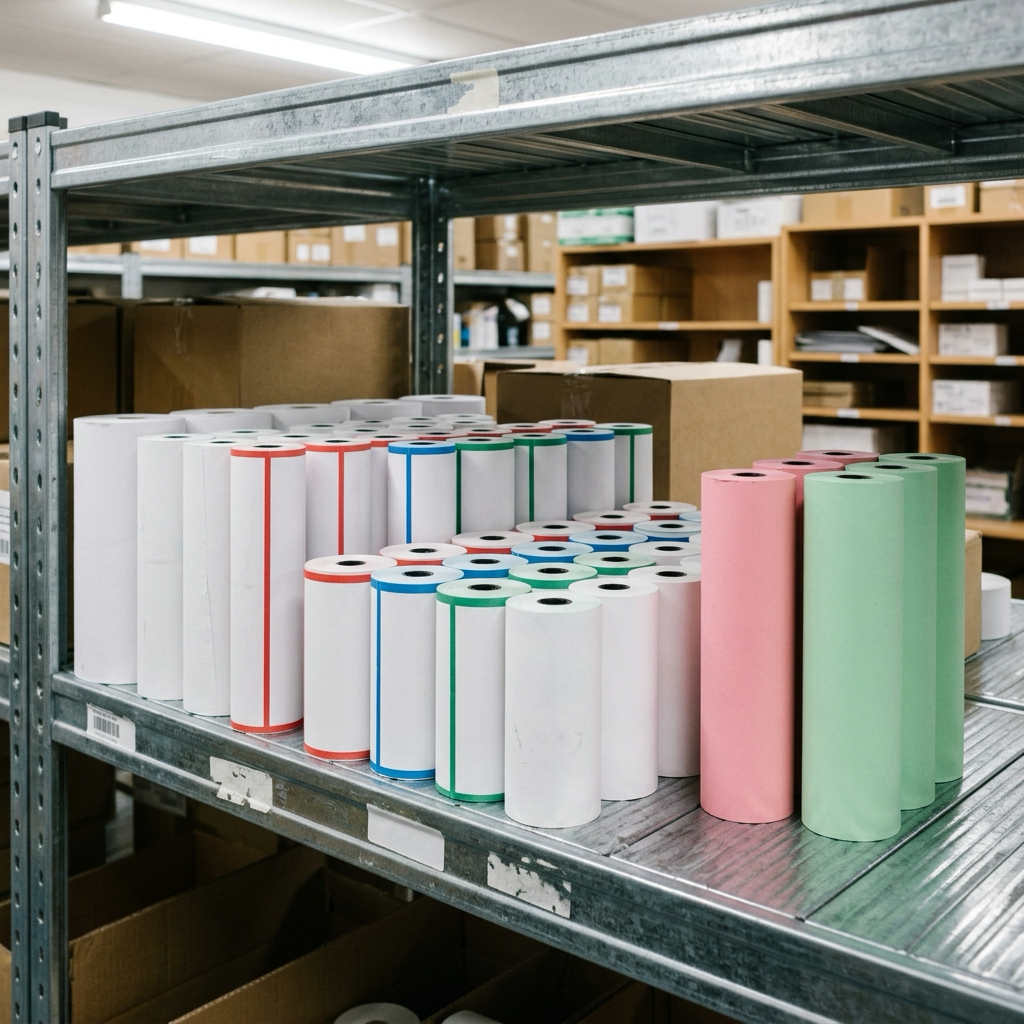
Colour belongs in a different budget conversation, and it keeps getting dragged into this one. Nothing changes on the machine: no printer setting, no platen, no cutter, no maintenance regime. Stock comes in both mainstream widths at the standard 50 rolls per case, in roughly five solid colours plus about three stripe options, with lengths matching white — 2 1/4" from 50' to 400', 3 1/8" at 220' and 230'.
Two formats solve two problems. Solid colour dyes the whole print face, so the customer physically receives a coloured receipt; pick it only when the colour is meant to be seen outside the business. Edge stripe is white stock with a coloured band along one edge, so the printed receipt looks entirely normal while the roll stays identifiable on the shelf and in the printer well. If your need is telling rolls apart without customers wondering what happened, the answer is stripe. That distinction settles most colour disputes before they start.
The industry conventions are conventions, not standards: green stripe for shift or cash-drawer identification, blue stripe for department or station coding, yellow or canary for early shift or register 1, red and pink solid for refunds, voids and manager-authorised transactions, green solid for verified or cleared for pickup. Which colour you pick matters far less than one written internal convention applied the same way at every site.
Only a narrow set of cases makes colour pay. Multiple cashiers sharing one printer is the cleanest: swap rolls at shift change and end-of-day reconciliation sorts by colour instead of timestamp. Refunds and voids on red let an audit pull exception transactions straight out of a stack, shortening dispute resolution and narrowing the window for internal fraud. Multi-station kitchens run blue for hot line and green for cold prep, so a misrouted ticket is visible across the pass. Outside those, coloured stock is cosmetic. It does not print faster, scan better or last longer.
Price it honestly and the decision gets easy. Solid colour 3 1/8" x 220–230' from a wholesale coloured receipt roll supplier runs $88.79–$119.95 a case, so $1.78–$2.40 per roll, stripe $116.50 or $2.33, against a white baseline near $1.20–$1.30. Net premium of $0.50–$1.20 per roll, the same 1.5x–2.5x band, against 6x–10x for linerless. Switching cost is effectively zero, so the trial is a single case, not a project.
Do Not Confuse Color Coding With The Red End-Of-Roll Warning Stripe
The red band near the core has nothing to do with colour coding, and buyers conflate the two constantly. Colour coding tells rolls apart on a shelf, or transaction types apart in a stack. The end-of-roll warning stripe is a pre-printed red band telling a cashier that paper is about to run out. It sorts nothing.
On datasheets it sits in the physical specs block beside 48 GSM or 55 GSM, worded as "End of paper: Red Warning Stripe at End Roll", "End-of-Roll Warning Stripe" or "Red end-of-roll indicator". It appears by name across ordinary stock: BuyRegisterRolls 3 1/8" x 273' 55 GSM and their yellow 3 1/8" x 180' 48 GSM, MilaMima 3 1/8" x 180' 48 GSM, TerminalDepot's Star TSP100III rolls at 3 1/8" x 230' 48 GSM, ReceiptPaperPro 2 1/4" x 65', Worldline Yomova 2 1/4" x 50' 48 GSM, and Pony Packaging 3 1/8" x 230' 55 GSM, along with stock specified for the Epson TM-m30II series and Star mC-Print3. Note the yellow roll there — a coloured roll carrying a red end stripe is a normal, orderable configuration, because the two specs are independent.
Placement runs along the final 3–6 feet, on one or both edges or as a centre band depending on manufacturer. The practical warning window is around 3–4 feet on most stock, 2–5 feet across brands. One or two more transactions, not a whole rush.
Write it as its own line item: Thermal receipt roll, [width] x [length], [GSM], [core size], [colour], end-of-roll warning stripe: red. Do not assume it ships by default on white, blue or pink coded rolls. The classic failure is reordering "same as last time" from a new supplier and receiving a whole batch without the stripe, discovered mid-transaction at a peak-hour register. The stripe adds effectively nothing to unit price and prevents the most disruptive paper failure at a register, so lock it into the standard spec first and argue about adhesive afterwards.
Where Plain White Thermal Paper Is Still The Right Answer
Most of the printers in your building should stay on plain white, and that is a design choice rather than a budget compromise. Plain white 80mm POS-grade stock runs $1.20–$1.50 per roll in bulk against $8–$12 for linerless of the same width, with $10 a realistic mid-point. A 7x–9x delta buys a feature set that goes entirely unused when the receipt's only job is reaching a customer's hand.
Some stations are unambiguous. Front checkout lanes running an Epson TM-T88V or Star TSP100III for receipts and card slips. QSR front counters where a KDS screen or a separate kitchen printer such as an Epson TM-U220 drives the line. Boutiques and pharmacies where the receipt is tax and return proof and the audit trail lives in the POS database. Self-checkout units printing exit validation scanned at the door. The common thread: no back-of-house routing, no order staging, no reconciliation by colour or position.
Linerless also carries operating burdens that never reach the quote. Exposed adhesive collects dust and fibre on the roll edge, surfacing later as feed failures, skewed printing and cutter contamination. A crooked linerless label cannot be peeled and repositioned the way a lined one can, so the ticket gets reprinted precisely when staff are busiest. Worse, batches with under-cured silicone release coating let adhesive migrate onto the thermal layer in storage, producing severe blocking inside the roll and outright jams — a batch-level defect that shows up as downtime, never as a line on the purchase order.
Storage tightens too. Plain thermal wants 20–25°C (68–77°F) and 40–65% RH, kept dark and dry, with 18–36 months of shelf life. The coating starts imaging near 70°C (158°F), and sustained 40–50°C (104–122°F) with high humidity brings background darkening and contrast loss. Sticky stock narrows all of it: 18–24°C (65–75°F), 40–50% RH, and typically 12 months of shelf life, so slow-moving adhesive rolls can expire on your shelf. That sensitivity is inherent to the coating itself, which is worth keeping in mind when you weigh how direct thermal compares with thermal transfer on the label side of the same fleet.
Which points at the real answer, and it is not a site-wide swap:
- If the printer hands output straight to a customer → plain white, cheapest per foot, zero handling risk
- If the ticket attaches to packaging at an expo or takeout packing station → linerless
- If the post is reconciliation-sensitive, meaning shared drawers, refund desks or multi-station kitchens → edge-stripe coloured stock
Each roll type lives only on the machine that needs it, and one thermal label and receipt roll manufacturer can hold all three on a single PO. Swapping a whole site to linerless pays the 7x–9x premium on every station including the ones that never touch adhesive, which is exactly how an ROI collapses into a negative one.
How To Pilot A Premium Roll Before Committing A Full Pallet
Nobody should buy a pallet of adhesive stock on the strength of a datasheet — ask for a trial case before switching. The same spec usually ships as a 12 rolls/case trial pack and a 32 rolls/case production pack, and the 12-pack costs more per roll — book that difference as R&D. Clean pilots graduate to production pricing like MAXStick X2 2 1/8" x 170' at $256 per 32-roll case, $8.00 a roll, or a second variant at $239, $7.47. Order the trial in the same width and core diameter as your current rolls so the media stays the only variable.
Run it on 1–3 representative terminals, mixing a peak-volume station with an off-peak one, for one full business week or 5 consecutive rolls per device, whichever takes longer. Zebra's guidance insists on the part suppliers gloss over: test on your own printers, because adhesive behaviour depends on your platen, cutter, duty cycle and ambient humidity. Print live tickets at typical density rather than test patterns, watch build-up on the printhead release coating, platen roller and cutter blade as you go, then inspect afterwards for residue, platen glazing and non-square cuts.
Fix acceptance metrics before the first roll loads, because deciding afterwards means deciding emotionally. No residue needing more than routine cleaning after 5 rolls, and none transferring onto the ticket face. 100% clean cuts, zero adhesive-attributable jams, no angle drift. Jam rate at or better than the plain white baseline, targeting 0 per 5 rolls. No drop in scan success against your current printed barcode label rolls, and no rise in reprints. Cleaning minutes no worse than baseline beyond an agreed threshold, with +20% failing outright.
Log roll changes, wasted tickets, cleaning downtime and jams per shift per printer, then compare against the plain white baseline over the same shifts. A published ROI template from a linerless deployment at 1,500 labels per roll and $21 per roll shows $11,900 gross annual saving less $1,500 of added maintenance, netting $10,400 a year. Copy that structure and add capex amortisation as a third line if a platen kit or new machine was involved. A roll that wins on gross saving and loses after maintenance and capex has failed, however good the tickets look.
Three clauses have to reach the contract: adhesive grade named as removable, semi-removable or permanent; pattern named as full, centre, diamond or side-edge; and an acceptance clause of no residue on cutter blade or tear bar after a defined roll count. Lock basis weight at 15# / 55 gsm or 21# / 74–80 gsm, plus roll length, core diameter and the warning stripe. Miss one and the next batch can legitimately arrive with a cheaper adhesive that passes your written spec and fails on your cutter. The pilot proves the product; the contract keeps you receiving it.
Conclusion
Colour and adhesive are not the same decision and should never share a meeting. Coloured stock costs $0.50–$1.20 more per roll with effectively zero switching cost, so if shift reconciliation or refund auditing is eating time, buy one case and find out this month. Sticky receipt paper costs 8x–12x per foot and drags a silicone platen, a non-stick cutter, an inverted cleaning routine and possibly a $2,000–$4,000 printer behind it. It earns that back in two places only: bag sealing and multi-item order labelling, both at volume.
Next steps:
- Walk the floor and mark every printer whose output physically sticks to something. That list, and nothing else, is your linerless candidate list.
- Confirm the red end-of-roll warning stripe is on your standard spec as its own PO line item.
- Check each candidate printer against the linerless-capable models before requesting a sample roll.
- Order one 12-roll trial case and run the 5-roll acceptance test with metrics agreed in advance.