Two quotes for the same job. Same die size, same 5,000 pieces, same artwork, and one lands around forty percent under the other. The cheaper supplier says the material is identical. Both may be telling the truth as they understand it, because neither quote lists the things that actually differ.
Cheap custom labels are rarely a scam. They are a stack of specific, defensible production decisions — shared press time, a lighter adhesive coat, no laminate, no press proof — that a quote has no obligation to spell out. Some of those cuts cost you nothing. One or two will cost you a reprint. Here is where the money comes out, stage by stage.
Gang Run Printing And The Color Consistency You Give Up
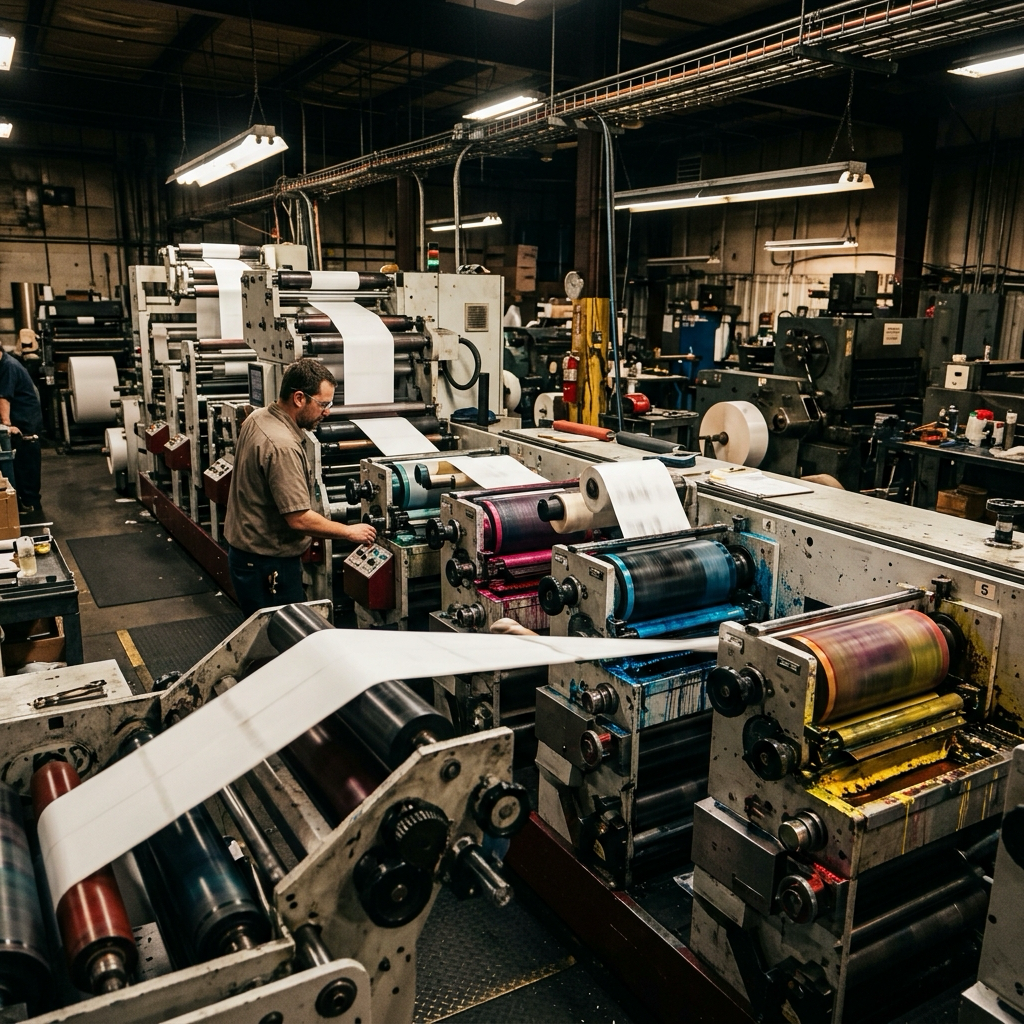
Cheap label pricing usually starts with a scheduling decision, not a material one. Your job rides onto a shared sheet with a dozen others, and everything on it runs the same substrate and the same process CMYK ink set — no ink reformulation for you, no tone curve tweak, no density zone control over your slice of the web. Standard semi-gloss paper and standard BOPP from Avery Dennison, UPM Raflatac and 3M gang most easily; exact Pantone matching, spot inks and tight-registration pharma work cannot gang at all.
The color cost is measurable. Commercial practice treats roughly ±10% deviation as normal run variation, which on a label lands near ΔE00 3–5. Under 1.0 is a lab-grade match, 2.0–3.5 is standard commercial print, and 3.5–5.0 is the shift you notice when last year's bottle sits beside this year's. Dedicated runs target ΔE00 ≤ 2.0; ISO 12647-2 allows ≤ 3.0 at the OK sheet. Gang work lives in the 3–5 band because the press will not be rebalanced for one customer.
It reaches you as density variation across the sheet, worth ΔE00 1–3 edge to center; as batch swing, where a color at ΔE 2 in March comes back at 4–5 in June and still counts as in tolerance; and as spot converted to process, where PMS 021 orange sits outside CMYK gamut and starts ΔE 3–5 off target before a press variable moves. One hard stop has nothing to do with color: 21 CFR 211.122(f) prohibits gang printing of drug labeling unless products differ in size, shape or color.
Ganging is an honest trade. The failure is that no quote carries a line reading "combination run, matched to a shared aim point." Make them write it, with a numeric ΔE acceptance against a signed master at M1 / D50 / 2 degree — any custom label printing manufacturer running dedicated plates can state both without hedging.
Facestock Downgrade: Where Paper Replaces BOPP In A Cheap Quote
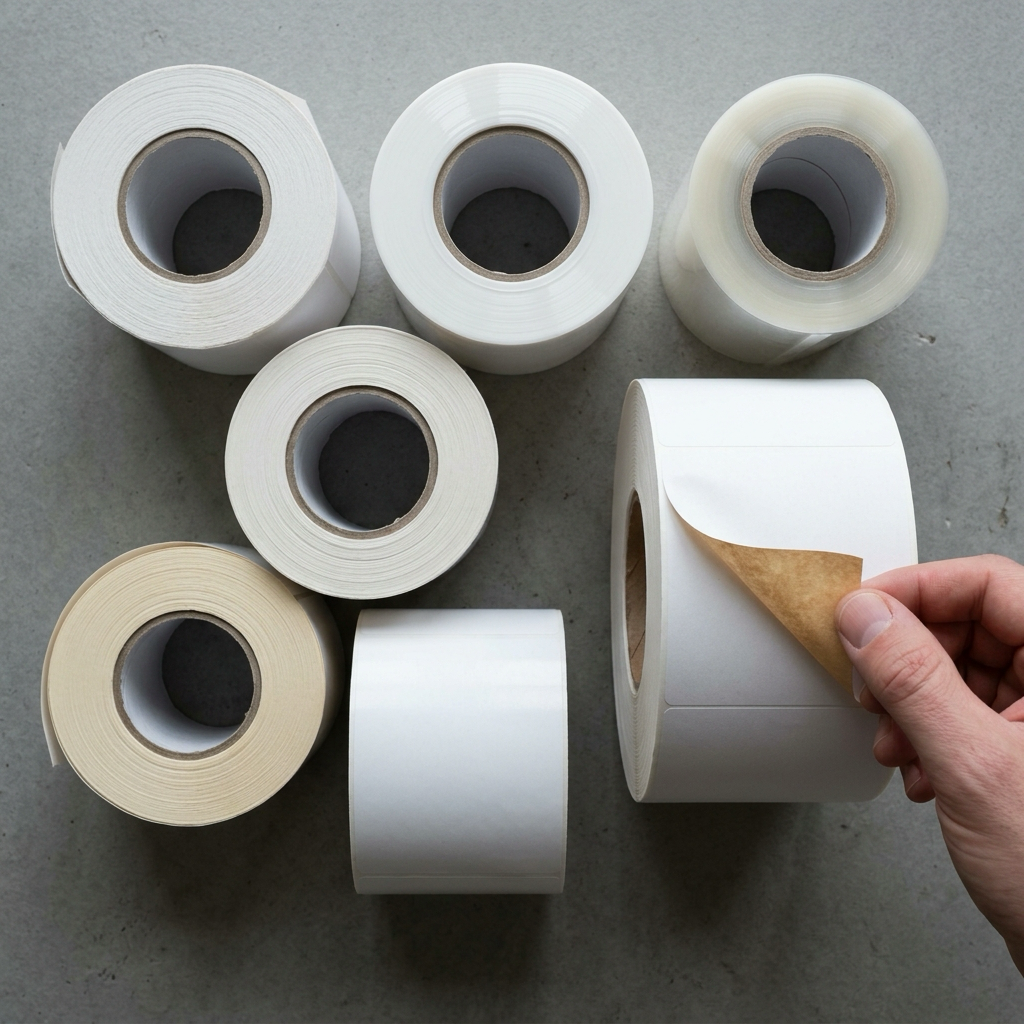
Set paper at 1.0 on a relative material index and BOPP runs 1.4–1.8x, PET 2.5–3.2x. That single swap moves more money than any adhesive or ink change available. Below roughly 10,000 labels the film premium is at its most visible per unit, which is exactly the order size where a quote gets quietly rewritten in paper — usually 70–80 gsm coated stock at 80–115 µm caliper, replacing 48–55 µm BOPP.
Paper is not the villain here, and most buyer advice gets this backwards. Dry indoor goods, or anything sitting inside a carton — pharma cartons, hang tags, dry food, dry-storage wine — nobody can tell the difference, and insisting on film there is spending money on nothing. The reverse mistake is just as common: BOPP on a six-week promo label buys service life the product will never live long enough to use. Where paper fails it fails on contact, and paper plus overlaminate is splash-resistant but never immersion-proof, because water wicks in at the die-cut edge.
The liner is the second cut and almost nobody asks about it. Low-cost constructions run 60–70 gsm glassine; high-speed dispensing wants 23–50 µm PET. Drop a PET liner from 23 µm to 12 µm and web stability under tension goes with it — a die nick becomes a tear initiation point, and the web breaks on an applicator running 100–300 labels per minute. That saving lands on the converter's material bill; the cost lands on your line as downtime. So ask for facestock brand, grammage and caliper with tolerance ("Avery Dennison Fasson MC Primecoat 80 g/m², 68 µm ±5%"), and ask separately whether the liner changed. The question applies to blank stock as much as printed work: even a bulk thermal label roll supplier should list liner caliper as its own line item rather than folding it into "4x6 white."
Adhesive Coat Weight: The Cut You Cannot See Until It Peels
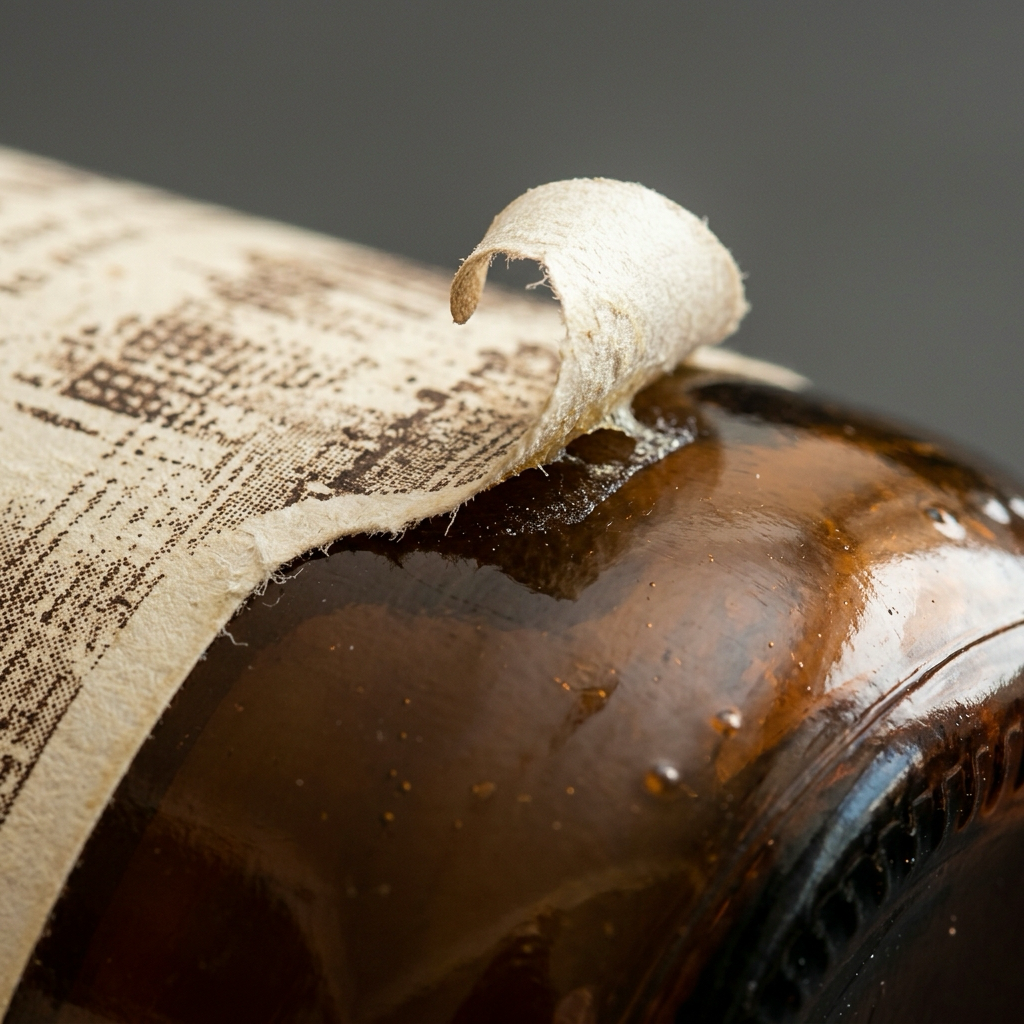
This is the cut I would worry about most, and the one almost nobody checks. Coat weight — dry adhesive mass per unit area in g/m², measured under FINAT FTM 12 — sits at 18–22 g/m² for standard permanent acrylic on paper. Below 16 g/m² adhesion failure risk climbs sharply; above 28 g/m² you get squeeze-out and die-edge contamination. Your quote says "permanent acrylic." It does not say 20 gsm or 13 gsm. Those two labels cost different money and behave differently three weeks apart.
The reason it survives inspection is a genuinely elegant piece of adhesive physics. Initial tack — loop tack under FINAT FTM 9 — is governed by chemistry and wet-out, not by how much adhesive is there. Avery Dennison's PET top white S8030 measures 16 N/25 mm loop tack on glass at 24 g/m², and a thinned coat reads nearly the same on day zero, so the label grabs hard when your QC person presses it down. Ultimate bond is the other story: FINAT FTM 1 / ASTM D3330 measures 180 degree peel at 20 minutes and again at 24 hours, and that 24-hour figure never climbs on a thin coat.
Drop 18 g/m² acrylic to 14 on HDPE and peel goes from roughly 8–12 N/25 mm to 5–7 — the border between permanent and removable behavior. Day zero looks fine. At 24 hours the bond misses spec. Around three weeks in, under thermal cycling and on curved surfaces, edge lift starts at the corners of square die shapes and the tightest radius. Incoming inspection catches none of it, because the failure is scheduled rather than visible.
Suppliers will try to file edge lift as a cosmetic complaint. It is not: a permanent adhesive is defined by not lifting, so one that lifts has failed spec. Put it in the contract as adhesive product code plus coat weight in g/m² with ±5% tolerance per FTM 12, and a 24-hour FTM 1 peel value on your substrate. An OEM custom roll label factory that buys named laminate stock reads those numbers straight off the material spec, so hesitation there tells you something.
No Laminate, No Varnish: What Ships Back Scuffed
Varnish and lamination get treated as interchangeable line items, and they are not the same product. An overlaminate is a physical film, usually 12–24 µm BOPP or PET bonded over the printed face, so abrasion has to grind through plastic before it reaches ink. Varnish is a liquid coating, UV flexo gloss at roughly 3–5 g/m² wet, working by lowering the coefficient of friction so labels slide past each other. It seals paper pores. It adds no sacrificial layer.
That distinction decides shipments. Wineries chasing an uncoated natural-paper look routinely skip both, and bottles vibrating against corrugated dividers arrive scuffed across the leading edge and the high point of the label curve. Digital toner and inkjet scuff more easily than conventional inks, which sets up the worst pairing in the business: the short-run digital job needs the laminate most and is the job where the buyer is most tempted to drop it. ASTM D5264 puts a number on it — 20 strokes of a 2 lb block against 9 µm lapping film, failure at an optical density change above 0.03, which laminated faces clear and unlaminated toner does not.
Then the cost curve turns, which surprises people. On short digital runs, gloss lamination adds roughly $0.005–$0.015 per label against UV varnish at $0.003–$0.008 — fractions of a cent apart. At volume the two price on different bases, and once the laminating station runs inline — as it does at a label roll factory with in-house converting — the per-unit cost converges with varnish and can undercut it. So "we removed the laminate to save money" mostly stops being true at scale. At 100k labels it buys a couple of points off the quote, paid for in transit damage and reprints.
Loose Die Cut Tolerance And How It Shows On The Shelf
±1/32 in appears on nearly every label quote in this industry and, by itself, tells you nothing. It is commercial custom, not a standard — no ANSI or ISO document mandates it for labels, which is why two quotes can both say it and mean different things. Three tolerances hide behind that one number, and they fail differently:
- Color-to-color registration — misregistration inside the artwork, showing as fringing and halos on type
- Image-to-die registration — usually the loosest of the three, and the real source of uneven-border complaints
- Die-cut dimensional tolerance — the size and shape of the cut label itself
Economy narrow-web flexo runs ±1/16 in image-to-die; good commercial work holds ±1/32 in; pharma and durable work reaches ±1/64 in and is priced accordingly, while HP Indigo class digital registration hits ±0.05–0.08 mm. Converter specs often pair a headline number with an escape clause — ±1/64 in color-to-color, with an allowance to ±1/32 in on a small percentage of the order — and that clause is where an expensive argument gets settled in the supplier's favor.
Here is the part that explains the price. Tight tolerance is bought with press speed. The color most sensitive to registration belongs at the print station nearest the die, for the shortest web path and least accumulated wander. Force it to a far station and the press must slow down to hold tolerance, which means fewer labels per hour. A cheap quote does not slow the press. It widens the tolerance instead, and does not mention that it did.
Defend yourself in the artwork: hold borders at least 1/8 in inside the die line, because a border tracking the cut line turns a few tenths of a millimeter of shift into one thick edge and one thin edge. On roll labels, confirm kiss-cut depth — the blade should score no more than 10–20% into the liner. Cut through, and the web breaks on the applicator. It is a fair question to ask any supplier, and worth a look at how our in-house die-cutting and slitting runs before you accept a number on faith.
Skipping First Article Approval And Ink Rub Testing
Every cut so far is a thing changed on the label. This one is a thing removed from the process, which makes it harder to see and easier to sell. A label line normally tracks ΔE, registration tolerance and First Pass Yield. Hold ΔE at 2–3 with stable registration and FPY lands around 85–90% in converting, scrap plus rework at 5–15% of units. With no in-process checkpoint there is no containment, so every defect gets discovered at your receiving dock instead of at the press.
Three tests should run before shipment and frequently do not. Ink rub resistance under ASTM D5264, or FINAT FTM 27 for UV work. Barcode scannability under ISO/IEC 15416, where GS1 requires only a minimum 1.5, Grade C, at point of use — no headroom at all, so a C symbol on a slightly scuffed label becomes a D at the checkout lane — if scanning is the whole job, buy barcode label rolls verified to ISO 15416 grade and ask for the verifier report with the shipment. And the adhesive pair: initial tack under FTM 9 and 24-hour holding power under FTM 1, of which only the second catches a thinned coat weight.
On the quote itself the omission is visible if you look for it. No first article or press proof line item, because a soft PDF proof is free while a real press proof runs roughly $100–$350 and adds days. No COA, no inspection report, no ΔE measurement traveling with the goods. A lead time short enough that the proof-and-approve window has clearly been deleted.
So ask how defects are counted and how they are compensated. With no QC standard a dispute collapses into two opinions. The arithmetic is not close — one first article costs a few hundred dollars and two days, one full-batch rework costs material, press time, air freight and a missed retail date.
Toner, Inkjet Or Flexo: How The Unnamed Ink Fails Later
Nothing on a standard quote tells you which press images your job. "Full color" covers dry toner, liquid toner, UV inkjet and UV flexo, and those four land in different places on every durability axis that matters. Variable-data work sits in a category of its own, worth comparing direct thermal against thermal transfer printing before you assume it belongs on the same press.
Toner bonds by heat fusing to the surface, and unlaminated its abrasion resistance is the weakest of the field: a fingernail scratch or transit vibration chips the fused particle layer off as white specks, most visible on dark solids. Unlaminated dry toner commonly fails under 100–200 rub cycles while properly cured UV inkjet and UV flexo hold 200–500 and beyond, so a reasonable QC target is 200 cycles at 4 lb on a Sutherland tester with no visible rub-off. Aqueous inkjet brings a different weakness — on uncoated paper the image bleeds and feathers under humidity, though the same ink survives fine on a topcoated film. UV systems crosslink into a hard polymer film, which is why measured UV sets run Blue Wool 7–8 across CMYK where dry toner scores materially lower.
Two omissions matter more than the ink choice itself. The first is white underprint. On clear facestock an opaque white layer is what keeps colors from going gray — without it, artwork that looked right on a white sample board turns muddy on an amber bottle and vanishes on a dark one. White is the most expensive ink on the press, needing the heaviest laydown and often a double hit, which is exactly why it disappears from clear-on-clear "no-label look" quotes.
The second is the brand color substitution nobody records. On a digital press spot colors are simulated, not mixed: HP Indigo with seven colors covers around 97% of the Pantone library, straight CMYK covers roughly 55–70%, and everything outside becomes a nearest-neighbor build. The cheapest route to "yes, we can match your Pantone" is converting it and skipping the spot ink and plate charge. Absent a written process, what you bought is whichever press happened to be free that day.
How To Read A Cheap Custom Label Quote Line By Line
The mistake that starts all of this is comparing two quotes on headline total price. When facestock, adhesive load, finishing and tolerances all differ, those numbers describe two different products. Build a one-page spec sheet, send the identical sheet to every supplier, and make them quote against it line for line. Any blank cell that comes back is your answer.
Seven fields force it into the open:
- Facestock — brand, grammage, caliper, tolerance. The word "paper" with no brand or number is the red flag.
- Liner — material, caliper, tolerance, on its own line. This is where a silent downgrade hides.
- Adhesive — product code and coat weight in g/m². "UPM Raflatac RP37 waterborne acrylic permanent, tack 11 N/25 mm per FTM 9" tells you something; "permanent acrylic" does not.
- Lamination or varnish — presence, type, thickness. An omitted finishing line is not "no charge," it is "no protection."
- Gang run or dedicated plates — an explicit statement either way.
- Tolerances — three separate entries. One combined number is a non-answer.
- Ink and imaging technology — UV flexo, UV inkjet or toner; spot inks versus process simulation; white underprint yes or no.
Write the application into the RFQ too: contact with water, oil or solvent; curvature band, above 75 mm, 40–75 mm or under 40 mm; surface energy, since PE at about 31 dyne/cm and PP at 29–31 are low-energy and need a specified adhesive while glass at 70+ does not; hand applied or automatic, and at what line speed. If the job also carries inventory tracking or tamper evidence, say so on the same sheet, because RFID inlays and tamper-evident security labels change the construction from the liner up. Nearly every wrong-adhesive story traces to one root cause: the buyer specified the label and never described the environment.
Then take control of the cut instead of leaving it to the factory. Name the permissions outright — varnish may be dropped; adhesive substitution not permitted; coat weight reduction not permitted; liner caliper change not permitted without written notice. Hold the price under those constraints and the cheap number was real. Fail to, and they have just told you where it came from.
Conclusion
Three things carry most of the weight here. Cheap is a set of named decisions rather than a mystery, and roughly half of them — paper instead of film on a dry indoor product, a gang run on non-critical artwork — are decisions you should happily buy. Adhesive coat weight and missing QC are the two that fail on a delay, weeks after incoming inspection signed off. And a headline comparison between two unequal specs is not a comparison at all.
Next steps, in order:
- Pull your last label quote and count how many of the seven fields are actually filled in.
- Rewrite it as a spec sheet and reissue it to that supplier plus two others.
- Add one enforceable number to the contract — coat weight in g/m² per FINAT FTM 12, or a ΔE acceptance value against a signed master.
- Buy the first article on any job over a few thousand pieces.
Send your spec sheet for a line-by-line markup along with your container and environment details before it goes out, and we will flag what is still missing.