A pallet lands at the back door on a Friday afternoon. The delivery note says "thermal 80mm", the cartons say the same, and the driver wants a signature. Nothing on the rolls tells you whether the paper inside is what you ordered, and the person who finds out is a store manager holding a printer that feeds, cuts, and prints nothing. The types of receipt paper in circulation separate by hand in under a minute with a fingernail, a warm mug, and a steel rule. What follows is the order I run those checks in at goods-in, and the point where I refuse a delivery.
Start With The Fingernail Test: Thermal Paper Reveals Itself In Seconds
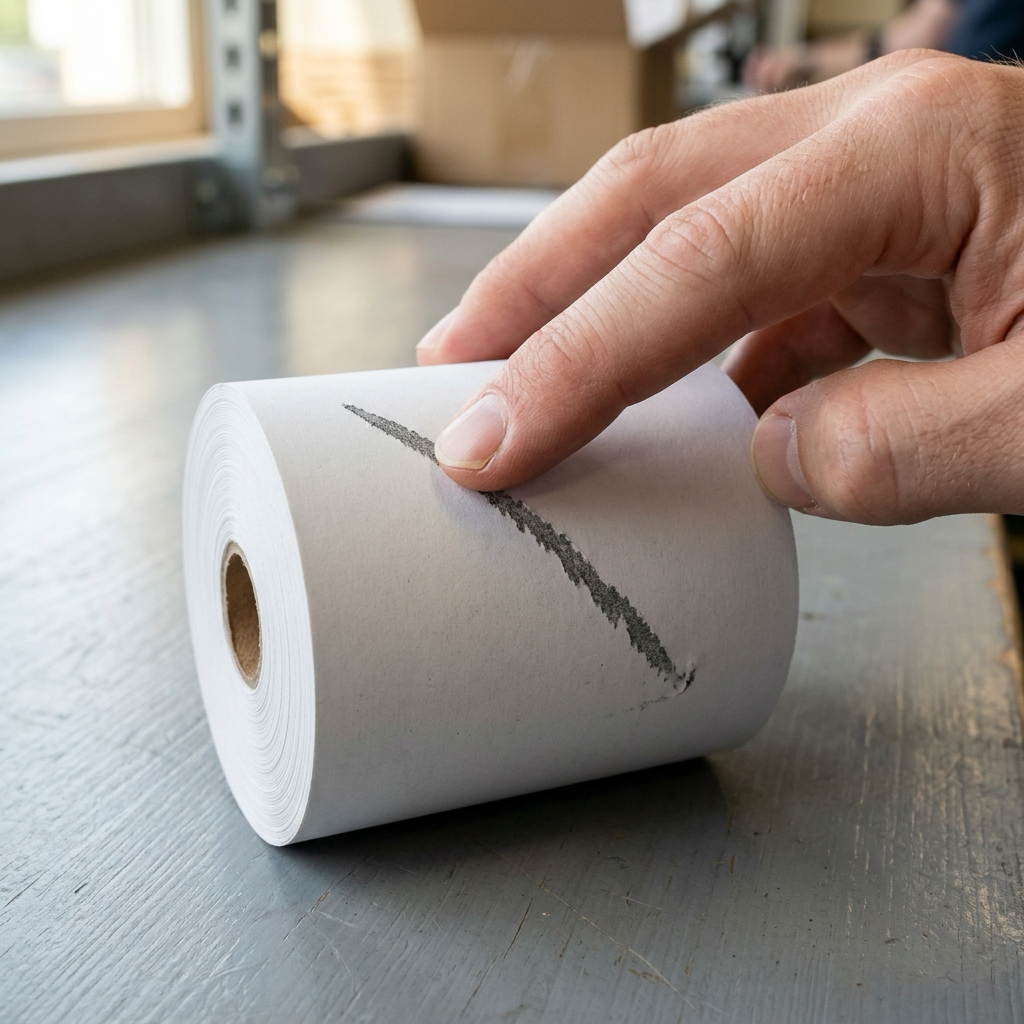
Tear off about 6 in (150 mm), lay it on something solid, and drag a fingernail edge across it hard and fast over a 1–2 in (25–50 mm) stroke. A grey-black line in under a second means that face is thermal-coated. Nothing on either face after a firm scratch means bond or carbonless, so move on to counting plies.
The mark is not a scuff. The coating holds a colorless leuco dye, an acidic developer, and a sensitizer. Friction heat melts the sensitizer, dye and developer react, and the image fixes chemically, exactly as printed text does. It cannot be erased. Most POS coatings work in a 60–90°C (140–194°F) band and blacken sharply near 100°C (212°F), and leuco systems flip across a window as narrow as 3°C (5°F). That is why a fast scratch works and a slow one doesn't.
Scratch both faces, always. A line on the outside surface means Coated Side Out: load it with the coated face toward the print head. A line on the inner-wound surface means Coated Side In, and that roll goes in flipped or every receipt prints blank. Test one face only and a CSI roll gets written off as "not thermal" and returned to a supplier who did nothing wrong. The same check hands you the loading direction for free.
Skip the smooth-or-waxy feel test. Plenty of bond papers are just as slick, and touch is the weakest discriminator you have. Read the mark instead: dark grey to black, instant, sharp-edged. Faint or patchy means a thin or poorly cured coating, a batch quality flag worth raising with your wholesale POS receipt roll supplier before the rolls go into stock. A coin, key, or paperclip edge works as well as a nail.
Ply Count And Color Order: The Fastest Way To Confirm Carbonless Receipt Paper
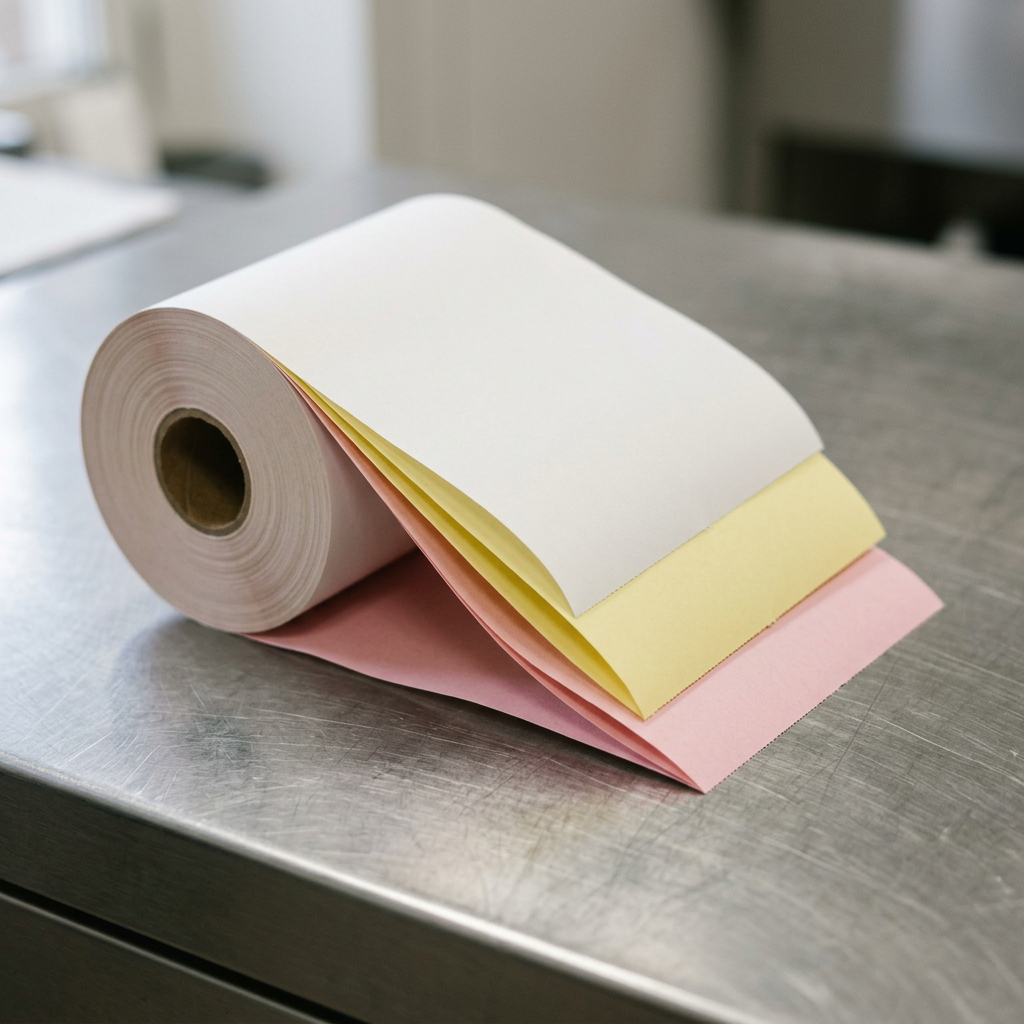
Count the layers before running any test. Thermal rolls are always single ply. Two or more plies wound together is carbonless — NCR — and nothing else needs checking.
| Plies | Color order | Coating code |
|---|---|---|
| 2-ply | White / Canary | CB-CF |
| 3-ply | White / Canary / Pink | CB-CFB-CF |
| 4-ply | White / Canary / Pink / Goldenrod | CB-CFB-CFB-CF |
Read the third column. CB is coated back, carrying the dye microcapsules; CF is coated front, the clay or resin receptor; CFB is coated on both faces and belongs only to a middle sheet. The code has to track the ply count. A 3-ply invoiced as CB-CF has no CFB middle sheet, and the copy your accounts team wants comes out blank. Medical and order-form stock often runs White / Pink in 2-ply.
Collation is the other half. Straight collated runs White → Canary → Pink → Goldenrod top to bottom. Reverse collated flips the stack, so a 3-ply reads Pink → Canary → White and feeds the opposite way. Order reverse for a site set up for straight and the legible copy ends up in the wrong hands. Part numbers encode this — part count, then R, REV, STR, or RS, then color order and size — so read the SKU before the pallet ships.
Per-layer weights sit in the 45–55 gsm band, with heavier pad and book grades at CB 83 / CFB 86 / CF 83. Run a fingertip over the back of the top sheet: the microcapsule layer, 3–10 µm capsules at roughly 3–5 g/m², feels like fine dry grit. Thermal and bond feel clean. Parent reels run 120–600 mm before slitting, and the receipt end of the market is almost all 2 and 3-ply in 3 in × 65–67 ft rolls, the two configurations any carbonless NCR receipt roll factory keeps on the floor, though impact sets go to 5 plies. Reject on two triggers: ply count that doesn't match the coating code, and reverse collation when the PO said straight.
Three Backup Checks When The Scratch Test Comes Back Ambiguous
Not every roll cooperates. Old stock, a cold room, a light hand — any of these produces a smudge you can't call either way.
Heat resolves most of them. Hold the strip against a warm coffee mug or a few centimetres from an incandescent bulb. Thermal greys or blackens across the whole heated area rather than in a line; carbonless and bond do nothing. Served coffee sits at 60–70°C, the bottom edge of the activation band, so allow a few seconds of contact. The glass envelope of an incandescent bulb runs 200–260°C and works faster. Take the strip from near the core, which has seen the least air and light.
The second check confirms bond by what it does, not by what it fails to do. Plain woodfree paper has no coating, no fingernail mark, zero heat reaction, and no capsule grit on the back. It images only with ribbon or ink — the same split that decides how direct thermal compares to thermal transfer on the label side — and its fiber texture is visibly coarser at an angle to the light. Thermal receipt stock runs 48–70 gsm, with 70–80 gsm for heavy duty. Kitchen bond sits at or above the top of that band and feels stiffer at the same width.
Third is the fastest of the lot when a printed sample is already in hand. Turn it over and run a fingernail across the back of the printed area. Impact and dot-matrix pins strike through the ribbon into the web and leave indentations you can feel. Thermal printing leaves no mechanical impression at all.
Still guessing? Print it. Thermal paper blackens instantly in a thermal printer and comes out blank in a 9-pin impact unit such as the Epson TM-U220, whose ERC-38 ribbon is rated for 3,000,000 black characters and will not put one of them onto a thermal sheet. Heat plus a thermal print confirms thermal; no heat reaction with embossing under impact leaves carbonless or bond, split by ply count.
Use The Wrong Roll Once And The Printer Tells You Immediately
There is a cruder identification method, and it costs a shift of receipts. Worth knowing, because the symptoms are specific enough to work backwards from.
Bond in a thermal printer produces blank receipts — not faint, blank — while the unit feeds and cuts normally. Run a self-test: a blank page there means paper or orientation, not POS software. Meanwhile the head runs dry against an uncoated sheet, pushing wear toward the 25 km end of a 25–50 km head-life range. A replacement head costs 15–40% of the printer's original price.
Thermal in a kitchen printer fails the other way: faint output or none, plus occasional feed jams. The ribbon is inked and working. The substrate is wrong, and a shift of blank kitchen tickets is the tell. Thermal that does print in a kitchen has a second problem — grill radiance, dishwasher steam, and fryer vapour push local temperatures past 60–80°C, and a ticket goes fully black within minutes, text vanishing into the background. Storage follows the same physics: above roughly 100°F (38°C) or in high humidity, rolls arrive pre-blackened, faint, or patchy.
Multi-ply in a single-ply printer is subtler. The TM-U220 is rated for one original plus one copy, so a 3-ply prints its top sheet normally while copies two and three come out blank or faintly embossed. That is strike force, not a paper defect, and total thickness above roughly 0.14 mm degrades transfer and jams the feed path.
The version that shows up at goods-in is 3 in kitchen bond booked in as cheap thermal. Both are three inches wide. The bond roll is 76.2 mm × 165 ft (50.3 m), 72.5 mm OD on a 1/2 in core, single ply, needing an ERC 30 / 34 / 38 ribbon; the TM-U220 takes ODs to 83 mm in 58, 69, or 76 mm widths. Route those rolls to the front counter and the whole batch prints blank. Label by station and printer type at goods-in — "TM-U220 kitchen bond" — on barcode label rolls that scan first time, and never sort receipt stock by width alone.
One boundary is worth memorising. Blank self-test plus blank receipts is paper or orientation. Correct self-test plus blank receipts is a driver, encoding, or template problem, and the roll is innocent.
Judge Grammage, Caliper And Top Coat Without A Micrometer
Grammage is where buyers get quietly overcharged, and the invoice is the wrong place to catch it.
Three grades cover most POS use. 48 gsm is cheapest and longest at a given diameter. 55 gsm is the industry default: better tear strength, sharper print, easier on the head. 60, 65, and 70 gsm run thicker and shorter on the same core. Below roughly 45 gsm you risk print-head damage and washed-out output, and no unit price justifies that.
| Grammage | Caliper (ISO 534) | Length at 80 × 80 mm | Roll weight |
|---|---|---|---|
| 48 gsm | 50–55 µm | 88–90 m | ≈338 g |
| 55 gsm | 58–62 µm | 80 m | ≈353 g |
| 60 gsm | 77–83 µm | 56–58 m | ≈280–285 g |
| 65 gsm | 85–90 µm | — | — |
| 70 gsm | 90–95 µm | ≈50 m | ≈280 g |
Read the length column, not the grammage column. Two cartons both marked 80 × 80 mm separate without any instrument: the one with visibly more paper is the 48 gsm, and roughly 10% shorter is the 55. In one market example, 48 gsm at 88 m for about $0.68 a roll works out to $0.0077 per metre, while 55 gsm at 80 m for $0.65 comes to $0.0081. The cheaper roll on the invoice is the more expensive paper per receipt, and the till changes rolls more often. I would still take the 55 gsm on a busy counter — head life and print sharpness are worth the premium — but make that a decision rather than an accident, and price it against bulk POS receipt rolls by the pallet rather than by the carton.
Top coat is a separate spec, easy to test by hand. The thermal layer runs about 6–8 g/m²; an acrylic or PVA top coat adds 1–2 g/m² over it. Rub a printed area with a wet fingertip, then scrape lightly with a nail. Uncoated paper smears and loses the image. Top-coated paper shrugs off water, oil, and plasticiser. Claimed image life is 5–7 years standard and up to 25 years top-coated, though that 25-year figure is marketing, not a test standard.
Shelf life is a different clock: 3–5 years from date of manufacture, stored below 77°F (25°C) at 45–65% RH, away from solvents, PVC, plasticisers, and sunlight. Check the production date at goods-in, and see how our slitting and QC line works before you commit to a converter. Stock that sat two years in someone else's warehouse has burned half its life before reaching your counter, and PVC sleeves, adhesive tapes, carbonless CF sheets, and alcohol-based cleaners finish the job on your own shelf.
Verify Roll Width, Diameter And Core Before You Sign The Delivery Note
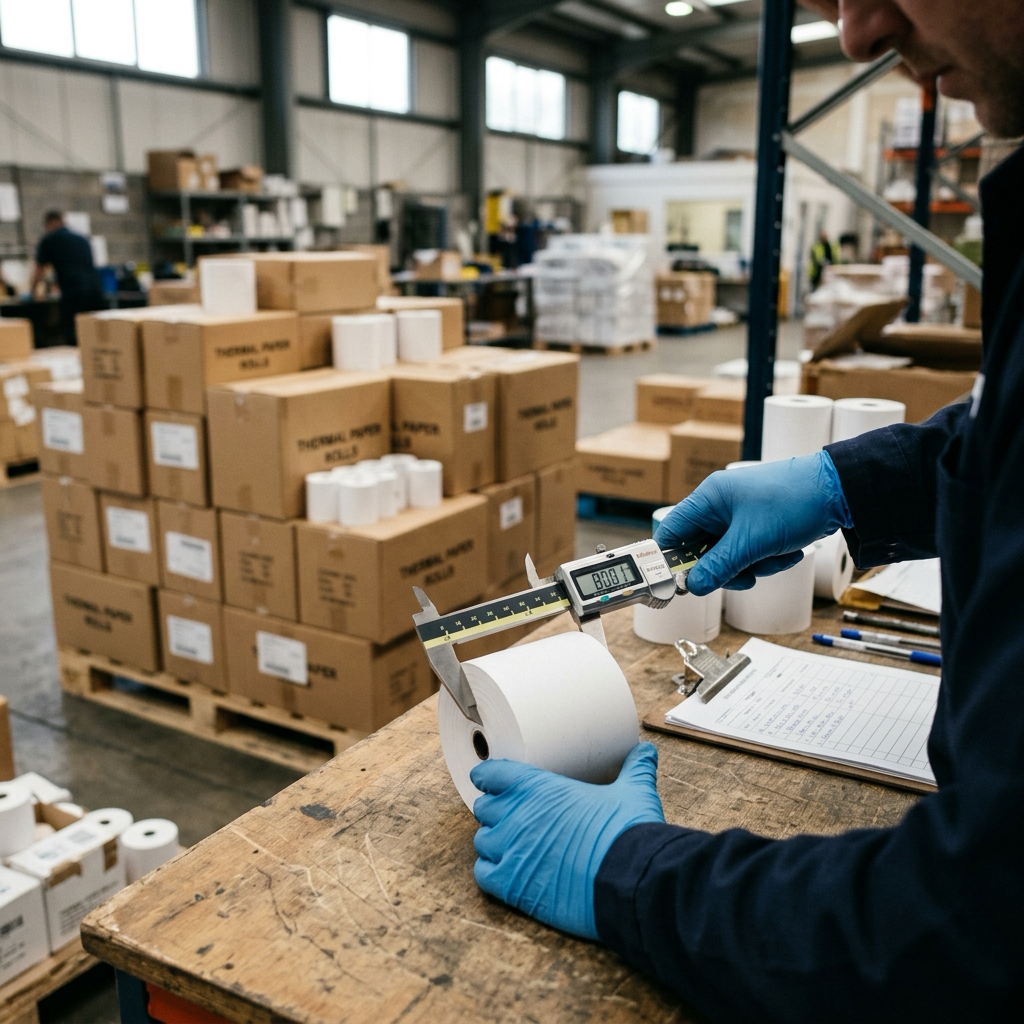
Signing the delivery note is the last moment you hold any leverage. After that the conversation is about credit notes instead of goods, and suppliers know it.
Specs read width × OD × core, or width × length × core, and the delivery note, carton print, and core print must agree. Two nominal widths confuse everyone: "80 mm" POS stock is really 79–80 mm, usually 79.4 mm (3 1/8 in), and "57 mm" and "58 mm" terminal rolls are one product at 57–57.5 mm (57.2 mm, 2 1/4 in). A supplier charging a changeover to move you from 58 to 57 is inventing the cost. Measure width straight across the web with calipers, never around the circumference; tolerance is ±1.0 mm, and anything past that is a rejection.
Diameter catches short rolls, and only on a full unused roll. The length-and-weight benchmarks in the grammage table above are what you measure against. A 230 ft (≈70 m) claim on an 80 mm width demands an OD near 80 mm at 55 gsm; measure 72 mm and the paper is not in there. Card-terminal 57 × 40 mm rolls run 18–22 m at 48–55 gsm, usually 60 to a case. The arithmetic settles arguments: L ≈ (π / t) × (R² − r²), with t the caliper in mm and R and r the roll and core radii. An 80 mm OD on a 12.7 mm core at 0.060 mm caliper gives about 81 m, so a 100 m invoice is short by a fifth. Quoting 230 ft and shipping 180 ft is the common version of that trick — a 22% cut that looks identical on the shelf.
Cores are standard at 12–12.7 mm (½ in) or 25 mm (1 in). The core must not exceed the roll width, must not sit recessed more than 1.5 mm from either end, and the wall should be 3 mm or less. Mixed 11 mm and 12.7 mm cores in one batch is a documented cause of unstable feed and image drift, invisible unless someone checks.
Sampling beats intuition. Pull three rolls per pallet and measure OD; one turn short on all three is systematic shrinkage, not variance. Weight cross-checks it — same width, OD, and gsm differing by more than 5% needs an explanation before signature. Write the rejection triggers into the PO: OD negative tolerance beyond 5%, core diameter not as ordered, missing end-of-roll warning stripe, production date older than 18 months. Any single hit and the note goes back unsigned — send us your roll spec for a quote if you want those tolerances written in from the start.
Phenol-Free Or Just BPA-Free: Reading The Chemistry Claim On The Pallet
No field test will tell you what developer sits in the coating. Scratch, heat, and touch identify paper type, never chemistry. The one exception is Koehler Blue4est, which uses no developer at all: a blue top layer with micropores that collapse under heat to expose a black underlayer, so the unprinted paper is visibly blue across a whole pallet.
The stakes here are regulatory. In the EU, Regulation (EU) 2016/2235 amended REACH Annex XVII Entry 66 to cap BPA (CAS 80-05-7, EC 201-245-8) in thermal paper at 0.02% by weight — 200 mg/kg, effectively a ban — from 2 January 2020. The US is a patchwork: Safer Products for Washington, rule WAC 173-337-114(3), restricts bisphenols from 1 January 2026 across manufacture, sale, and distribution; Connecticut and Minnesota run their own statutes; California Prop 65 can trigger warnings above exposure thresholds. Shipping into those states, "BPA-free" is not enough, because the restriction covers BPS too.
That gap is what most buyers get wrong. Conventional thermal paper carries roughly 1–2% BPA by weight as the developer — a functional ingredient, not a trace contaminant — and "BPA-free" almost always means BPS-substituted, a structural analogue with its own regulatory exposure. Phenol-free is a different claim: a non-bisphenol developer, or none at all. Swiss monitoring shows what the rules produced. BPA as developer fell from 82.2% in 2013/14 to 10.8% in 2021, while BPS climbed from 3.1% to 19.1%. The industry substituted rather than solved.
For genuinely phenol-free stock, name the system in the PO. Pergafast 201 from Solenis (CAS 114006-71-0), a urea-based sulfonyl compound, reached about 60% of the Swiss market by 2021 with print performance essentially equal to conventional thermal, and it is what I would specify by default when sourcing from a phenol-free receipt paper manufacturer. Blue4est earns its place where visual verification and long archive life matter, on a vendor claim of up to 35 years. Ascorbic-acid systems are expensive and heat-unstable, and I wouldn't build a supply chain on them.
Ask for substance disclosure naming the developer and its CAS number, a COA per batch, and a regulatory statement for the destination market. A sticker is not disclosure. Accept "phenol-free" only when the paperwork names a non-bisphenol system or no developer at all, and put that wording in the contract — chemistry is the one property here you can never check at the loading dock.
Conclusion
Three checks separate almost everything on a pallet: count the plies, scratch both faces, then apply heat if the scratch is ambiguous. Single ply that marks is thermal, two or more plies is carbonless, and no mark with no heat reaction is bond. The expensive checks come after that — footage against diameter, production date, and a developer named on paper rather than on a sticker.
Next steps:
- Add the fingernail-and-heat sequence to your goods-in checklist, testing both faces of every new roll type.
- Pull three rolls per pallet, measure width across the web and OD on a full roll, and weigh one against spec.
- Put four rejection triggers in the PO template: OD short by more than 5%, wrong core, missing end-of-roll stripe, production date older than 18 months.
- Request the developer CAS number and a per-batch COA before the next order ships.
If a delivery fails any of these, refuse it at the door, and take the spec back to a thermal label and receipt roll manufacturer that will put it in writing. Everything is easier before the signature.