A pallet comes out of the −20 °C room with half its labels lying loose in the bottom of the case. The supplier says the application temperature was wrong. You say the material was wrong. Both sides are guessing, because nobody looked at what the failed label left behind on the carton.
That argument repeats every season — on outdoor tags that faded pink, on hot-fill containers whose barcodes stopped scanning after the tunnel. Weatherproof custom labels rarely fail as a whole. One layer fails, and the fix depends on which one — a distinction worth forcing on any custom label printing manufacturer before a replacement gets quoted.
Diagnose Which Layer Failed: Facestock, Ink, Adhesive Or Topcoat
A dead label carries its own evidence. Photograph it in place, then peel one off and read what it left behind — that single observation splits the diagnosis in half.
A clean surface means wet-out failure; the adhesive never made molecular contact. Suspect a substrate under 36–38 dyn/cm, a frost or condensate film at application, mould release, or silicone. Smeared adhesive means cohesive failure: the mass split internally, from an adhesive too soft for the service temperature, plasticiser migrating out of flexible PVC, or a rubber hot melt above its heat limit.
The rest of the triage runs as a decision tree:
- On the floor, container clean → adhesive, wet-out. Fix the application temperature or the surface.
- On the floor, adhesive smeared → adhesive, cohesive split. Change chemistry, not aggressiveness.
- Still stuck, print washed out → ink or topcoat; the facestock is fine.
- Edges lifted, centre bonded, flat or large-diameter container → facestock. Heat shrink, or a laminate-facestock shrink mismatch.
- Chalky, micro-cracked, brittle → facestock again. UV chain scission and plasticiser loss in PVC or vinyl.
Small-diameter containers are a separate question — rule geometry out once, then move on.
Three of those five verdicts point away from the adhesive, exactly the layer most buyers replace first. Ink anchorage gets its own check: cross-hatch per ISO 2409, where worse than rating 1 means print delamination, not adhesive failure. Cold-chain topcoats embrittle around −10 °C (14 °F) while the bond underneath stays perfect; specify one rated to flex at −20 °C (−4 °F).
Minimum Application Temperature Versus Service Temperature Range
Two numbers on one datasheet get read as one, and the gap causes more cold-chain failures than any material defect. MAT is the lowest temperature at which the adhesive still flows enough to bond; STR is what the label survives once that bond cures. MAT always sits well above the bottom of STR — a construction rated to serve at −50 °C can still demand +10 °C at application. Go below it and you get a dry bond, then a label on the floor within minutes.
Standard paper and film PSAs run MAT +4 °C to +10 °C (40–50 °F), with paper facestock serving −54 °C to +93 °C (−65 °F to 200 °F) and film up to +149 °C (300 °F). Chiller grade sits at MAT +4 °C (39 °F), STR −30 °C to +70 °C (−22 °F to +158 °F). Freezer grades land in a −4 °C to −12 °C (+25 °F to +10 °F) band, specialty formulations at −18 °C to −29 °C (0 °F to −20 °F). UPM Raflatac's RP48-class freezer acrylic serves to −40 °C (−40 °F) yet is still written for application at or above 0 °C (32 °F).
Peel at 20 minutes is initial tack, at 24 hours ultimate bond; FINAT FTM 1 and ASTM D3330 ask for both because the gap is where field failures hide. Allow 24 hours at recommended conditions before pushing a fresh bond into extreme cold.
Most buyers get this backwards: freezer grade is not the upgrade, it is the specialty. It gives up UV, heat and solvent resistance. Buy it only when the application step itself happens cold — label at ambient and chill afterwards, and a chiller-grade acrylic with a −40 °C service floor ages better.
Freezer And Blast-Chill Constructions: Hot Melt Rubber Or Acrylic
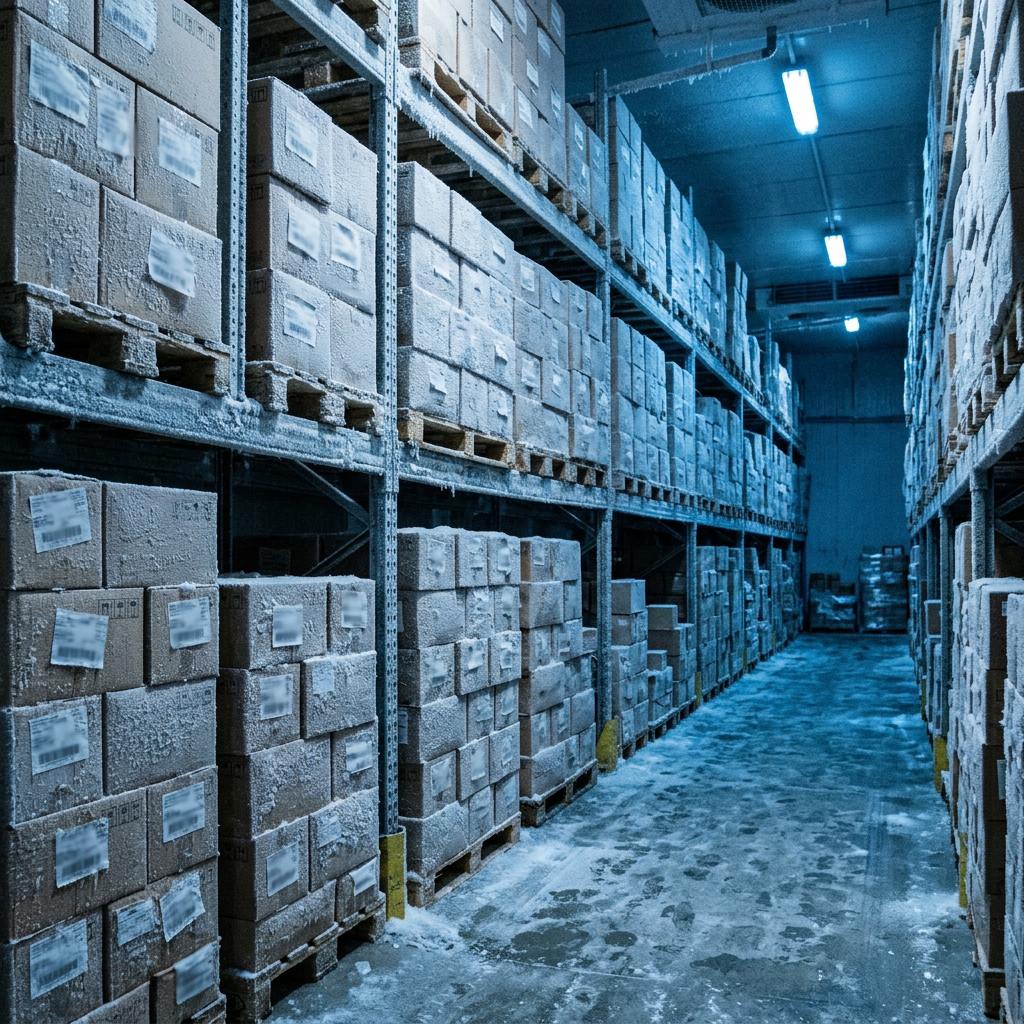
The choice between the two cold adhesive families comes down to whether the surface is dry when the label lands.
Freezer-grade hot melt rubber applies down to −26 °C to −29 °C (−15 °F to −20 °F) in the aggressive grades. Service runs −54 °C to +49 °C (−65 °F to 120 °F), and that ceiling is the limiting number. Initial tack is very high and wet-out near-instant, so it holds on frosted and blast-chilled surfaces where acrylic slides off. Bostik Thermogrip H2259-01 applies to −26 °C on paper and polyolefin; Technicote Sub Zero runs MAT −23 °C (−10 °F), STR −40 °C to +60 °C, shear 180 min at 22 °C. Against that: poor UV and heat resistance, and common solvents wipe it off.
Freezer acrylic applies at −18 °C (0 °F), and specialty solvent versions such as the Avery Dennison C7501 class reach −40 °C (−40 °F). All-temperature acrylics serve −54 °C to +93 °C (−65 °F to 200 °F) with good to excellent UV, ageing and chemical resistance — the only cold family that also survives outdoor and hot cycles. It will not grab a frosted or wet surface.
Tier by environment: commercial freezer at −18 °C to −25 °C takes coated paper or PP with either family, verified by ASTM D3330 peel at −20 °C. Blast freezers and IQF tunnels, where the product freezes immediately after labelling, take hot melt rubber and nothing else.
One trap belongs only to printed labels. The construction is a stack — laminate, ink build, facestock, adhesive — each layer contracting at its own rate. Through freeze-thaw the stack curls and the edges peel while the adhesive under the centre stays bonded, so the lab report comes back clean and the wrong layer takes the blame. Match laminate chemistry to facestock: PET over PET, PP over PP, and write that stack into the order — a wholesale roll label printing service will otherwise default to whatever laminate is already on the press.
Sunlight Exposure: What The Overlaminate Actually Protects
Most buyers assume a laminate is a laminate. A plain gloss or matte overlaminate buys abrasion resistance, a finish and a modest moisture barrier — no UV-absorber package, and essentially nothing for fade. A UV-inhibited film carries benzotriazole or triazine absorbers plus HALS stabilisers, soaking up the 270–400 nm band and shedding it as heat before it reaches the ink. That package is sacrificial, consumed across the rated life.
UV-cured inkjet on polymeric vinyl, unlaminated, gives 3–5 years vertical in a moderate zone; add a UV overlaminate and it reaches 5–7. 3M Scotchcal 8518–8915 overlaminates rate 8 years on flat vertical outdoor surfaces, 8528 rates 9, and Avery Dennison DOL 1060Z lifts inkjet durability to about 5 years. Calipers come at 1 mil (25 µm) and 2 mil (50 µm); the heavier film buys edge stability and abrasion, not UV protection.
Orientation matters as much as material. Graphics more than 10° off vertical lose about 50% of rated durability, and 45–90° off vertical falls outside warranty. Zone 2 runs roughly 75% of Zone 1, Zone 3 takes about 40% off, and Zone 3 plus non-vertical mounting can strip 70%. Phoenix and Miami collect 1.6–2.5× the annual 295–385 nm dose of northern sites, and a south face collects 2–3× the north face — two identical labels on opposite sides of one enclosure can differ twofold in service life.
Red, magenta and yellow desaturate first; blue and carbon black hold longest, which is why the logo goes pink while the barcode still scans. Direct thermal imaging has no place outdoors — sunlight keeps the coating reaction running, greying the image out within weeks, which is the sharpest version of the direct thermal versus thermal transfer trade-off. Settle that question before ordering blank stock from a direct thermal label roll supplier. Sun-exposed jobs move to thermal transfer with a resin ribbon on PET or PP, or UV-cured and latex ink under an inhibited laminate, rated by ASTM G154 QUV or ASTM G155 xenon arc.
High Heat And Steam: Where BOPP Stops And Polyester Starts
The switch point is not subtle. BOPP holds continuous use to about 100–110 °C (212–230 °F); PET runs 150–175 °C (302–347 °F). Industrial PET systems are commonly written −40 °C to +150 °C (−40 °F to 302 °F), the standard construction inside UL 969 recognised marking. A weatherproof BOPP consumer label typically states −20 °C to +90 °C (−4 °F to 194 °F), and MACtac's UL 969 PP system reaches −40 °C to +93 °C with minimum application +10 °C (50 °F). Avery Dennison SF-100 PET goes −40 °C to +125 °C (−40 °F to 257 °F) but demands +16 °C (61 °F) at application.
Dimensional stability matters more here than melting. PET does not shrink inside that window, so high-density barcodes stay in tolerance through oven and wash-down cycles. BOPP softens and stretches under sustained heat: bars widen, the bar-to-space ratio drifts, and a code that verified at grade B on press leaves the oven undecodable. Nothing looks wrong to the eye — the label is stuck, a human reads it fine, the scanner refuses. Ask for FINAT FTM 10 dimensional stability, % change after 24 h at 70 °C, whenever code density is high; high-density barcode label stock is where that tolerance disappears first. Steam is harsher than dry heat at equal temperature, since moisture attacks the adhesive-facestock interface and drives edge lift far faster.
Changing the film changes the print job. PET sits at 43–47 dyn/cm; untreated BOPP sits at 29–31 dyn/cm, below the 36 dyn/cm LSE cutoff, so corona or a receptive topcoat is mandatory — and corona decays. Press settings, cure energy and ribbon type cannot carry across unchanged. Re-run peel to FINAT FTM 1 (180°, 300 mm/min, stainless steel, 25 mm strip, 2 kg roller) or ASTM D3330 Method A/F at both dwell points.
Surface Energy Testing Before You Blame The Adhesive
Reaching for a stronger adhesive on a low-energy surface changes nothing, and that instinct burns more reprints than any other habit. On an LSE substrate the adhesive beads up like water on a waxed car — contact area approaches zero, so peel collapses whatever the datasheet promises.
36 dyn/cm is the industry cutoff; ≥38 dyn/cm is where wet-out becomes reliable, and the substrate should sit 8–10 dynes above the surface tension of whatever goes onto it. Untreated PP and BOPP land at 29–33, HDPE at 30–32, PTFE at 18–20 and effectively unbondable without primer. PET reads 43–47, rigid PVC 39–42, stainless steel 40–50, glass 200+. Corona lifts PP and BOPP into 38–44 and PE into 38–46, then decays over days to weeks as slip agents and antistats migrate back.
Measure with a dyne pen: a line that holds continuous for two seconds puts the surface at or above the pen rating. Resolution is about 2 dyn/cm; ASTM D2578 dyne solutions tighten that to ±1–2 dyn/cm.
Field procedure beats table values. Dyne-pen the container lot the customer actually received, off the pallet that will run — published figures describe virgin resin in a laboratory, while the container on your line carries mould release, regrind, handling oils and sometimes condensation. For long shelf-life products, never lean on corona alone; specify a primer or a topcoated facestock. For genuinely LSE work, compare the named families rather than generic aggressive stock: 3M 300LSE and 9471LE, Avery Dennison S692N and S490, UPM Raflatac RP37 and RH8. On PE, write down initial tack above 20 oz/in and 40+ oz/in after 24 hours. Coat weight has to stay consistent roll to roll for those numbers to mean anything, so ask about the converter's slitting, die-cutting and quality control setup as well.
Qualification Tests To Run Before Approving A Reprint
Rule zero costs nothing and prevents most disputes: every coupon must be a finished, printed and laminated label on the actual container. Blank facestock off the roll is more compliant than the production build, so it passes tests the real label fails. Match the container on supplier, mould cavity, resin lot and recycled content too — regrind and release residue move measured peel more than most adhesive changes do.
The cycles that earn their place:
- 24-hour dwell at 23 °C / 50% RH, then edge-pick every corner. Any edge that starts is a fail.
- Mandrel bend on the full production construction: 32 mm for labels up to 100 mm long, 16 mm up to 75 mm, 8 mm for small formats; inspect for flagging after 24 h.
- Freeze-thaw from −20 °C to ambient, minimum 5 cycles, 4–8 h dwell at each end; ISTA cold-chain profiles cover the packaged version.
- Accelerated weathering per ASTM G154 QUV (UVA-340, 8 h UV at 60 °C / 4 h condensation at 50 °C) or ASTM G155 xenon arc.
- Water immersion per ASTM D870 for 24 h, then re-run FTM 1 against the dry 24-hour baseline.
Name the peel method by revision underneath — FINAT FTM 1 or ASTM D3330 Method A/F — and add FTM 9 loop tack when the line runs fast.
Put numbers in the purchase order instead of adjectives: minimum peel in N/25 mm at 24 h on the real substrate, a maximum percentage drop after freeze-thaw and immersion, zero edge lift at 10× after 5 cycles, incoming substrate ≥38 dyn/cm, and laminate caliper with the UV inhibitor confirmed. Cite UL 969 where the label carries regulatory marking, and qualify RFID inlays and tamper-evident security labels separately — an antenna and a destructible facestock move through freeze-thaw differently than a plain film does.
Read The Material Datasheet Before You Trust The Sales Claim
"Weatherproof" is a marketing word with no test behind it. Five TDS lines carry the real commitment: outdoor life in years with the exposure condition attached, service temperature range with continuous and short-term peak kept separate, minimum application temperature, peel method and revision with both dwell points, and certifications — UL 969, FDA 21 CFR clauses for indirect food contact, BS5609 for marine.
3M's UL-recognised white polyester stock states a 5–49 °C (40–120 °F) application window and −29 °C to +150 °C (−20 °F to 302 °F) long-term resistance. 3M Performance Paper 7000 serves −40 °C to +121 °C (−40 °F to 250 °F), applies at 10 °C minimum, and carries 24 months of shelf life. Avery Dennison FC 300 gives up to 1 year outdoor unprinted vertical, +10 °C minimum application, −20 °C to +80 °C service; FT-126 publishes 849 N/m peel per ASTM D3330 at 180°. UPM Raflatac separates service min, service max and short-term peak — a distinction most sales sheets collapse into one number.
Push hardest on the outdoor-life figure: which basis produced it, natural weathering or accelerated exposure, how many hours were run, what factor converted them into years, and whether the rating covers unprinted film or the printed and laminated construction. Most published figures describe unprinted stock, and ink plus laminate move the answer both ways, so request the printed and laminated construction datasheet rather than the bare film's.
Close the loop commercially. Copy MAT, STR and outdoor life verbatim into the PO in the datasheet's own units, attach the TDS version and date, and require written notice before any facestock, adhesive or laminate change. That revision string is the only traceable anchor you have, and it turns a dispute into a document comparison.
Conclusion
Three things carry most of the weight. Read the failed label before replacing anything, since three of the five common verdicts point away from the adhesive. Separate MAT from STR on every quote — a construction rated to −40 °C service can still need +5 °C at the moment it goes on. And qualify the finished printed and laminated label on the real container, never blank stock from the roll.
If failures are already in hand, that evidence outranks any datasheet. If the job is still being specified, write the exposure profile before asking for a price.
Next steps:
- Photograph and peel-test one failed label, recording clean versus smeared residue.
- Dyne-pen the container lot from the pallet that will run.
- Copy MAT, STR and outdoor life from the TDS into the PO with the revision number.
- Run 5 freeze-thaw cycles or an ASTM G154 exposure before approving the reprint.
Then take those numbers to a converter willing to put them in writing — send the exposure profile for a written quote.