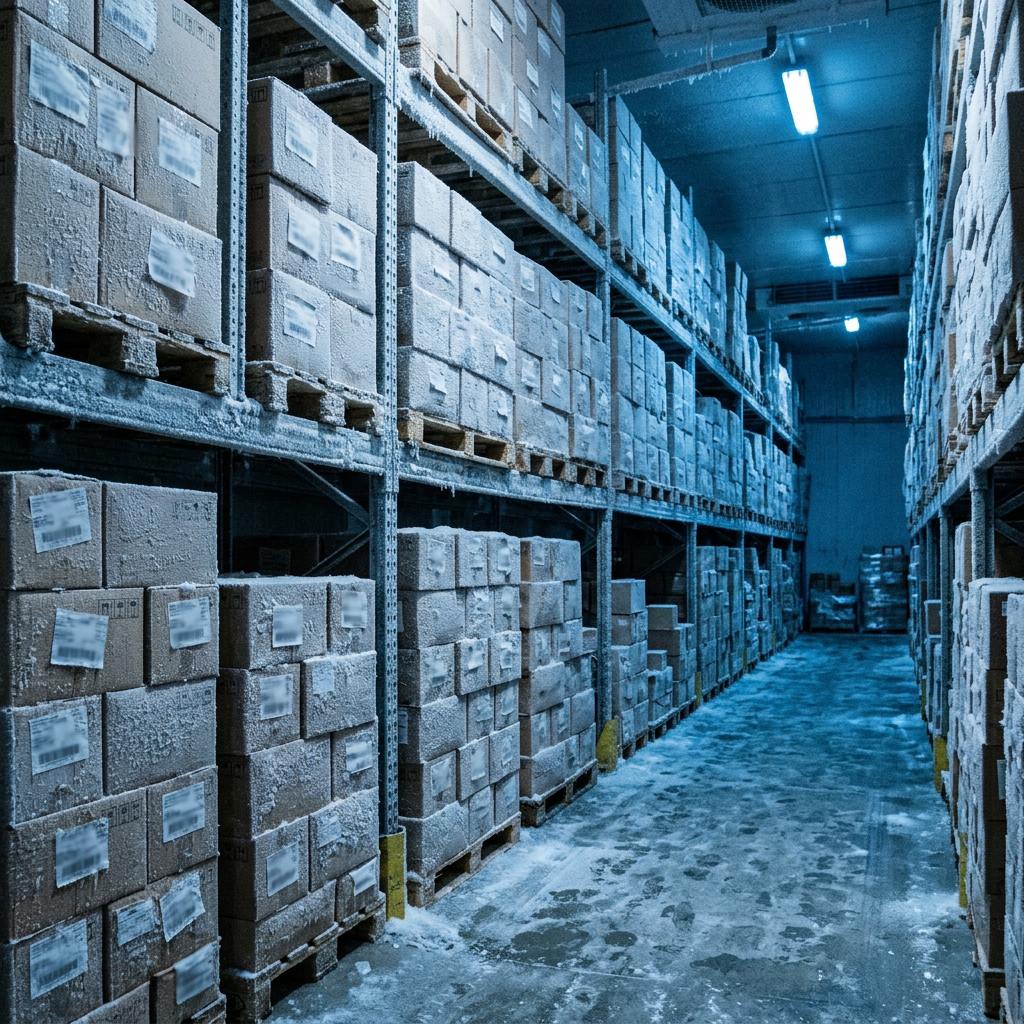
The quote says 1,000 labels at $0.09 each and 5,000 at $0.03. Your rep says what reps always say: order more, it's cheaper. On the spreadsheet it certainly looks that way — two-thirds off the unit price for four thousand extra labels.
Whether that holds depends on something the tier column never shows: how much of each price is setup you'd pay regardless. This piece works through where those fixed costs come from, where the steep part of the curve actually ends for small custom labels, and how to spot the point where extra stock turns into money you never get back.
The Fixed Costs That Create Every Custom Label Price Break
Every label quote hides a bucket of costs that stays the same size no matter how many labels you buy: plates, a cutting die, makeready, prepress. On flexo that bucket is commonly modelled at around $400 per SKU. The digital equivalent — file prep, a couple of minutes of alignment — sits near $25.
Work through a real one. Twenty minutes of press setup at a $210/hour burden is $70 of machine time. Six plates at $80 each is $480. That's $550 of fixed cost before a single saleable label exists, identical whether you ordered 500 or 50,000. Then divide: the same $480 of plates costs $0.24 per label at 2,000 and $0.0024 at 200,000. Hundredfold swing, no change in material.
So the tiers on your quote are not volume discounts; nobody hands you cheaper paper at 10,000. Minimums work the same way. Flexo converters commonly quote 5,000–10,000 labels per SKU against the same converter's digital minimum of 250–500 — a MOQ is a pricing artefact, not a refusal. Ask a bulk custom label printing factory what its digital minimum really is and the number usually drops.
The useful question is what share of a tier is fixed. At 2,000 labels with $550 fixed and roughly $0.03 per label running, fixed cost is about 90% of the invoice; at 50,000 it's 15%. Until you know that numerator you cannot tell whether the next tier saves anything.
Plate Charge Per Color: Why Four Colors Move Your Break Even
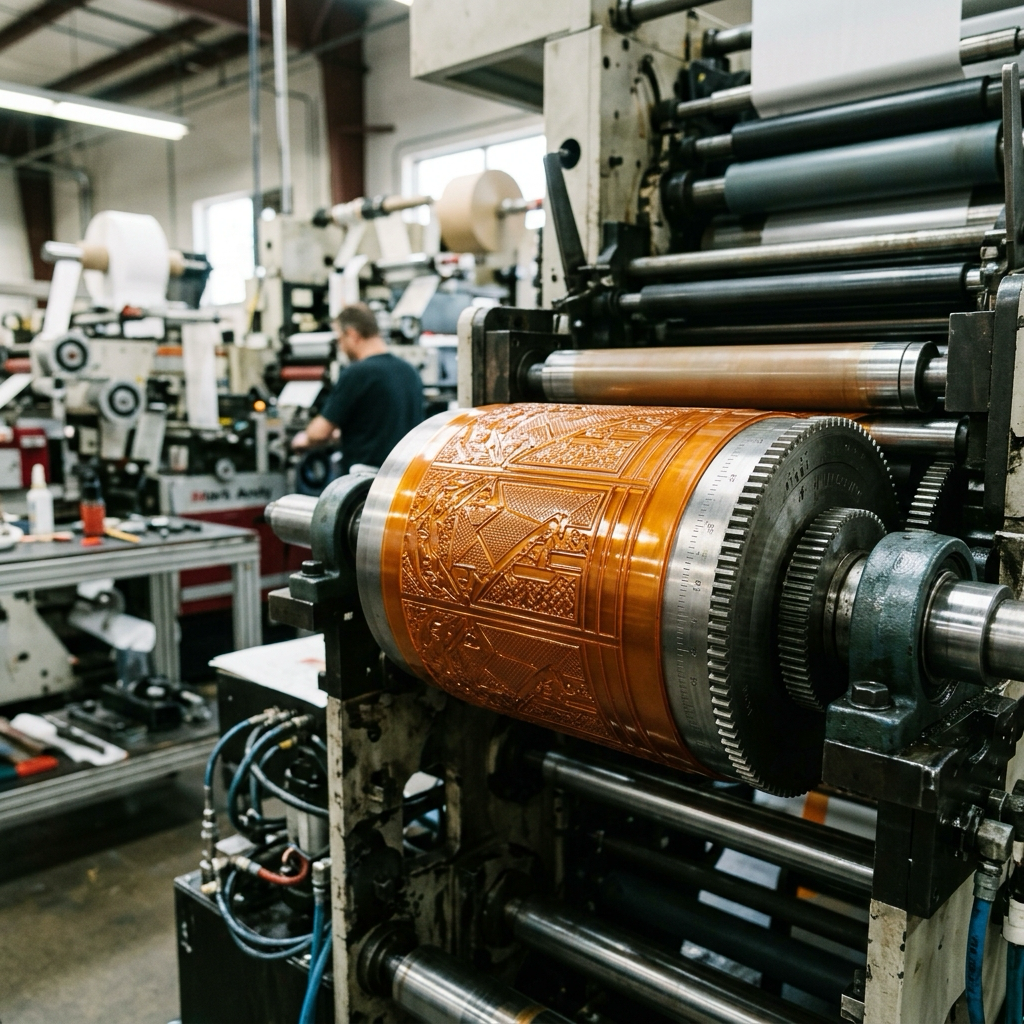
Plate prices are quoted per colour, and the published ranges are wide enough to be useless on their own. $50–$300 per colour is the most-cited label band. Narrow-web plates run $110–$295, film and large-format work reaches $200–$600, economy trade shops go as low as $40.
What matters is the figure after you multiply by colour count. Four colours at $50–$300 is $200–$1,200; at $150–$400, $600–$1,600; at $200–$600, $800–$2,400. Six-colour work lands between $1,500 and $3,600, before per-change fees of $12 a plate and $16 an ink station.
Digital carries no plate, so colour count barely moves price. Adding a fifth colour there is an artwork decision; on flexo it's a $50–$600 decision, repeated per SKU. That repetition catches people out. Ten SKUs at five colours is 50 plates — $2,500 at $50 each, $10,000 at $200, $15,000 at $300 — all payable before you ship anything.
Colour count drags the crossover by thousands of labels as well. Simple 1–2 colour jobs see flexo overtake digital around 2,500–5,000. Standard 4-colour sits near 5,000, where vendor examples show digital at $750 against flexo's $650. On film with an expensive plate set it pushes out to 15,000–20,000. The mechanism is plain arithmetic: a 4-colour BOPP label with $500-per-colour plates carries $2,000 of tooling, and against a $0.30 per metre running-cost gap that's 6,667 metres to break even. Halve the colours and break-even halves to 3,333.
Die Tooling Fee And When The Cutting Die Gets Reused
Ask for a custom shape and a separate line appears on the quote. Simple label dies start around $50–$300 and commonly land at $200–$500, itemised on their own, then divided by quantity. Solid rotary dies, machined from steel, are $800–$1,400.
The part that changes the picture: the die is a one-time charge and the converter stores it — worth a minute to see where those dies are stored. Retention runs 1–2 years of inactivity, after which it may be scrapped and a fresh fee applies. Any change to size, corner radius or shape starts a new die.
Which makes amortising it over your first order the wrong sum. A $350 flexible die is $0.35 per label over 1,000, $0.07 over 5,000, and $0.023 over 15,000 across a year's reorders. An $800 rotary die over 50,000 is $0.016, or $16 per 1,000. Set against digital run pricing of $85–$120 per 1,000, a $300 die adds $300 per 1,000 on a 1,000-label order and $60 per 1,000 at 5,000 — the die alone swings your effective price more than threefold.
There's a way to pay nothing for it. House dies — circles, squares, ovals, rectangles — carry no tooling charge, and some converters hold 2,000+ shapes; designing to one deletes the whole $200–$800 line, which for small custom labels is usually the highest-return decision. Ask an OEM custom label printing supplier for its shape list before anyone draws a new outline.
Makeready Waste: The Quantity Tax That Never Appears On A Quote
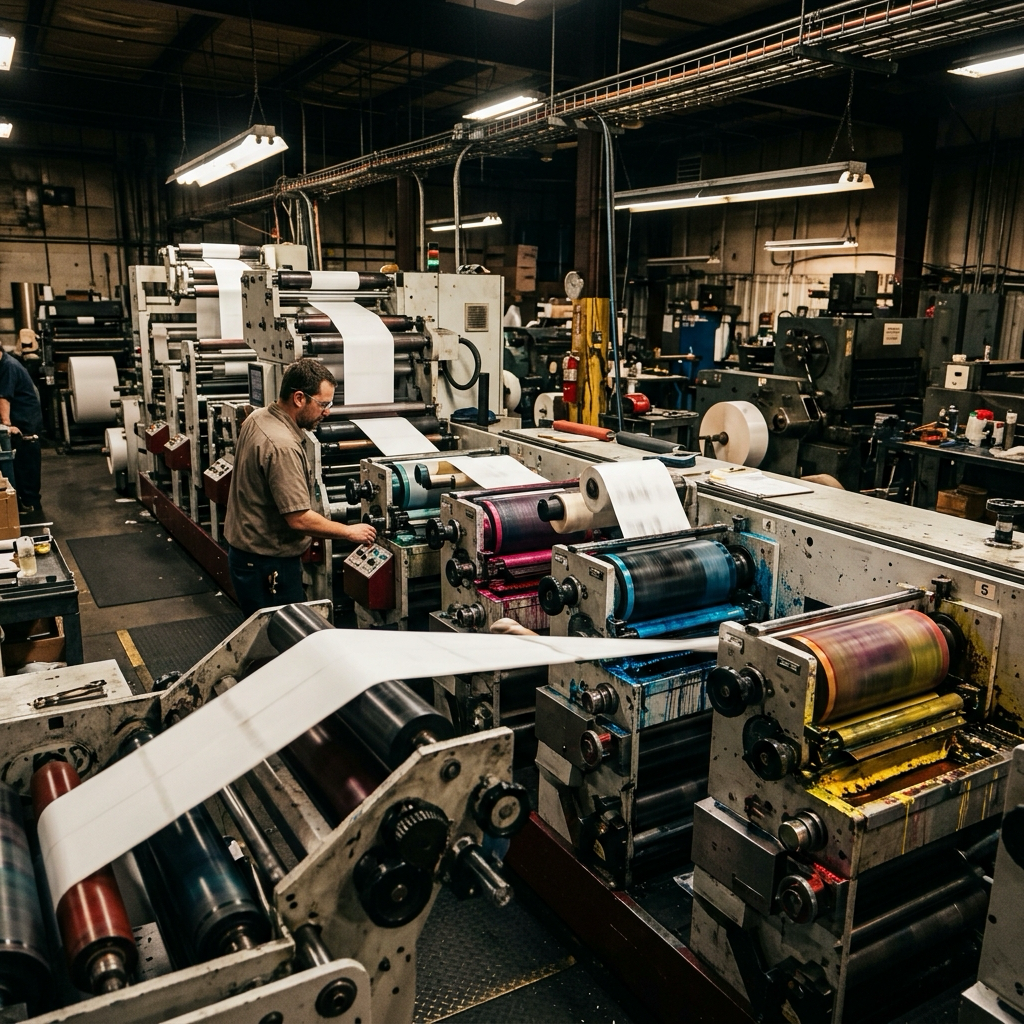
Nothing on your quote says "wasted substrate," and yet you paid for several hundred feet of it. An 8-colour flexo job burns 300–800 feet dialling in registration and colour; other benchmarks put changeover waste at 150–500 feet, and procurement guides allow 500–800 linear metres of startup waste. Digital uses 5–15 feet for a same-SKU changeover.
The length is fixed. Your order size is not. That gap is the whole tax.
Minutes cost money too. Flexo changeovers run 20–45 minutes typically and 30–60+ on complex or older presses; digital is 5–15 minutes. A 20-minute flexo setup at $210/hour is $70 gone before anything saleable exists. Flexo short runs waste 8–12% of material against digital's 2–7%, and the yield arithmetic is unforgiving: 7% web waste plus 1.5% die loss leaves 91.6%, so you buy 1,092 labels for every 1,000 you ship.
One UK converter's numbers make the shape obvious. 500 flexo labels cost £150 tooling plus £20 print — 34p each — while the same 500 digital, no tooling, £40–£60 print, lands at 8–12p. At 5,000 the flexo price falls to 7p and digital holds at 8–12p. A 79% drop on one side, almost nothing on the other — all of it setup and waste spreading thinner. Nobody itemised that for you. Once amortised, flexo at 5,000–100,000+ runs $25–$45 per 1,000.
Where Digital Printing Stops Being Cheaper Than Flexo
No two sources name the same crossover, which should tell you something. Vendors most commonly cite 2,000–5,000 labels per SKU. Others say 3,000–8,000, 5,000–10,000, or 8,000–12,000 per design. Flexible packaging brands often don't find flexo cheaper until 10,000–50,000 per SKU, four-colour on film pushes to 15,000–20,000, and broad rules of thumb reach 30,000–80,000.
They're all correct, because each quotes its own cost structure. The formula behind every number is identical: break-even equals the setup gap divided by the per-unit gap. Flexo setup $500, digital $0.15 a label, flexo $0.05, so $500 ÷ $0.10 = 5,000 labels. At 4,000 digital still wins; at 6,000 flexo does. Change one input and the answer moves an order of magnitude — flexo setup $400 against digital's $25, per-unit $0.017 versus $0.010, gives $375 ÷ $0.007 ≈ 53,000 labels. Same formula, tiny per-unit gap, crossover ten times further out.
Two things push the real crossover later than the quoted one. Comparisons routinely omit flexo's 10–20% makeready waste and 20–60 minutes of changeover per SKU. And digital's advantage stretches further across several SKUs sharing a run window, because each flexo SKU repeats the plates and the setup.
Anyone quoting a single universal number is describing their own factory. Ask a China label roll manufacturer instead: at what quantity should this job move from digital to flexo? That forces setup cost, press speed and waste allowance onto the table.
Reading A Price Break Table In Cost Per Thousand Labels
Put a real tier table in front of you and the trick becomes visible. Two 2-colour SKUs, different artwork:
| Quantity | Total | Per 1,000 |
|---|---|---|
| 1,000 | $510.57 | $510.57 |
| 3,000 | $522.63 | $174.21 |
| 6,000 | $540.42 | $90.07 |
| 25,000 | $666.86 | $26.67 |
| 50,000 | $854.38 | $17.09 |
| 100,000 | $1,176.25 | $11.76 |
The per-1,000 column is the one that misleads. Strip the one-time charges first — prepress $120, plates $290, plate changes $48, ink changes $46, so $504 fixed. Subtract that from the 100,000 total and $672.25 of running charge is left, roughly $6.72 per 1,000. Now read the first row again: you're paying $510 per 1,000 for under $7 per 1,000 of printing. Ninety-nine percent of that tier is amortised setup, and the apparent 66% "discount" between 1,000 and 3,000 is the same $504 divided by three.
What you actually want is the marginal price. From 1,000 to 3,000 costs $12.06 for 2,000 more labels — $6.03 per 1,000; from 3,000 to 6,000 it's $5.93; from 25,000 to 50,000, $7.50. That band barely moves, and it never falls the way the headline column does, because it is pure material and press time. Once the marginal price stops falling you're buying substrate, not leverage — and that point arrives far earlier than the table's shape suggests.
So ask for three quantities in one quote (1,000 / 3,000 / 5,000 works) with setup, plates, die and per-1,000 running cost itemised separately. Flexo quotes conventionally list plate setup outside the per-M price and exclude dies entirely. If yours doesn't show them, they're buried in the unit price — and a buried number can't be compared against anyone else's.
What To Do When Your Volume Sits Below The Break
Under 2,000–3,000 labels, or roughly 1,200 linear metres, digital nearly always wins. Under 5,000 it still wins against any flexo setup in the $400–$500 range. Four routes are worth knowing below that line, and they aren't equally good.
If the labels are internal — barcodes, batch IDs, date codes — blank pre-die-cut roll stock printed in-house carries no plate and no die: $5–$15 per 1,000 for blanks, $5–$20 for ribbon and toner, and no brand colour. That is where bulk blank thermal label rolls earn their keep, though it pays to compare direct thermal against thermal transfer before you commit to a ribbon spend.
If you need brand colour under 1,000 pieces, go digital short run. $0 plates and $0 setup are standard at many digital vendors, minimums are 250–500 per SKU, and 1,000 labels comes in near $180. The trade is CMYK simulation over spot colours, plus a house-die shape to dodge the $200–$800 tooling line.
If you run several variants, pay for one die and share it. A $400 die across 10 SKUs at 3,000 labels each adds $0.013 per label; the same die on one 3,000-label SKU adds $0.13. Tenfold difference in burden, identical printing — provided every variant keeps the same size, shape and material.
If you have many variants at low volume each, print a generic base. Run the fixed brand graphics once at 20,000–50,000 labels, where flexo unit cost reaches $0.05–$0.10, then overprint batch codes and dates in-house at $5–$20 per 1,000. Plates $800–$2,400, die $200–$800 and 300–800 feet of makeready land once, and only on the part of the label needing press-quality colour. Small brands underuse this more than any other option here.
Judge whichever route fits on total spend rather than unit price. Digital at 1,000 is $180, flexo at 1,000 is $420, flexo at 5,000 is $650. Buying up to chase a better per-piece figure costs $470 more cash and hands you 4,000 labels you may never use.
The Small Orders That Get Priced Like Big Ones
Eight flavours, 500 labels each, all in slightly different sizes. On paper that's a 4,000-label order. On the press floor it's eight dies, eight plate sets and eight makereadies — a heavier fixed load than one 10,000-label job carrying a single die, plate set and setup.
Priced out: eight dies at $200–$500 is $1,600–$4,000, eight two-colour plate sets is $800–$4,800, and eight makereadies at 20–45 minutes on a $210/hour press is $560–$1,260 of press time plus 2,400–6,400 feet of scrapped substrate — all landing on 4,000 finished labels. As one SKU on one die, the same 4,000 would carry roughly an eighth.
Fixed cost repeats per design, not per order. Everything here follows from that line.
Consolidation is the fix, and it's a design decision made months before anyone requests a quote. SKUs sharing size and material share a die and a single setup. Digital presses take multi-variation work at no extra charge and no per-version minimum, so a 4,000-label order split eight ways prices much like one 4,000-label run. A short-run custom label printing service should show that plainly on the quote.
A second lever most buyers never pull: quote annual volume separately from per-order volume. A one-off 5,000 gets priced as a digital job at $120–$220 per 1,000. Described instead as twelve orders a year — 60,000 annually — it can be quoted as a flexo print-and-hold at $20–$60 per 1,000. Your supplier cannot offer that if they only ever see one order, though settle who stores the stock and who absorbs obsolescence before believing the number.
So count distinct die shapes and plate sets before you count labels. If the fixed-cost item count climbs faster than the label count, your small order is being priced as a large one.
When Buying Up To The Next Tier Turns Into Dead Inventory
A 30% cut in unit price is not a 30% saving, and reading it as one is the most expensive mistake in this whole exercise. True cost is the price saved minus tied-up cash, storage and obsolescence risk — and carrying cost runs 20–30% of inventory value per year.
Run it against the tier table from earlier. Stepping from 6,000 ($540.42) to 25,000 ($666.86) saves $63.40 per 1,000 while committing $126 of extra cash and 19,000 labels of stock. Consume 6,000 a year and that's three years of supply against a 12-month material shelf life. The saving is spent before it's earned.
Labels don't spoil so much as go stale. Sesame became the ninth major allergen under the FASTER Act, forcing reprints across affected food SKUs from 1 January 2023. FDA and USDA FSIS set compliance dates in two-year intervals precisely so companies can use up existing stock — rules published 2023–2024 carry a 1 January 2026 date. GS1 forces a new barcode when gross weight shifts by more than 20%, so stock carrying GS1 compliant barcode labels can go stale faster than the paper does, and certification and ingredient changes trigger reprints too.
Not every change is a write-off, mind you. GS1's Sunrise 2027 adds a 2D barcode at the next natural print run, no emergency reprint.
The adhesive adds a harder clock. Manufacturer sheets say pressure-sensitive material should be used within one year of purchase, and rolls held beyond 12–18 months sit outside warranty and want a peel test before going near an applicator.
One justification survives less often than people expect: order extra now, never pay setup again. Dies are retained 1–2 years and unchanged reorders skip plate and artwork charges anyway, so those costs weren't coming back.
Conclusion
Three things carry most of the weight here. The steep part of a price break curve is fixed-cost dilution, so it flattens as soon as setup is spread thin — usually long before the top tier. The digital-to-flexo crossover comes out of your own job's arithmetic, never a published band. And a lower unit price only counts as a saving if the stock gets consumed inside twelve months.
First order? Stay digital, keep the shape standard, and don't buy up a tier until the marginal price says so.
Next steps
- Ask what share of each tier is one-time cost
- Ask at what quantity this specific job should move to flexo
- Check whether your shape exists in the converter's house die library
- Compare total spend against twelve months of realistic consumption
Ask for your next quote itemised — setup, plates, die and running cost on separate lines. Or ask us to itemise your label quote and compare it line by line against the last one.